

Of all the tools in the pizza-making arsenal, the cutter is the most taken for granted — and the one most likely to ruin the final thirty seconds of an otherwise perfect bake. Everyone has lived through the sad sawing: a dull little wheel dragging cheese across the pie, tearing the crust, turning distinct slices into a mangled cheese blanket. The pizza deserved better. Finding the best pizza cutter for your style of pizza is a small investment that pays off every single pizza night, because the cut is the last thing that happens before eating, and it shapes the entire experience of the slice.
Here’s the thing most guides won’t tell you: there is no single best pizza cutter, because different pizzas need different blades. A thin, crackery crust wants a different tool than a puffy Neapolitan or a two-inch-deep Chicago pie. The classic rolling wheel that most of us grew up with is genuinely excellent for exactly one job — standard medium-thickness pizzas — and mediocre at everything else. Once you understand the three main cutter families and what each does best, you’ll stop fighting your tools and start slicing with the kind of clean confidence that makes guests notice.
This guide covers the full slicing toolkit: wheels, rockers, and scissors; what separates a great wheel from a drawer-clutter wheel; the servers and boards that complete the setup; professional cutting technique; and how to keep your blades performing. By the end, you’ll know exactly which cutter deserves a place in your kitchen — and which ones to leave on the store shelf. Your pizzas have waited long enough for a clean cut; let’s fix the final thirty seconds for good.
🍕 Key Takeaways
- The classic rolling wheel is best for standard medium-thickness pizzas; a rocker (mezzaluna) blade excels at thick, crispy, and loaded pizzas.
- Kitchen shears are the sleeper pick — unbeatable for clean cuts through heavy toppings without dragging cheese.
- Look for a large, sharp stainless blade, a comfortable full-grip handle, and a blade guard for safe storage.
- Let the pizza rest 1–2 minutes before cutting, then cut with firm, decisive pressure — never saw back and forth.
- Always cut on a board, never on your stone or steel, and match your cut pattern (pie-cut vs. party-cut) to the pizza style.
- A wide pizza server (not a flimsy spatula) is what gets slices from board to plate intact.
The Three Cutter Families: Wheel, Rocker, and Scissors
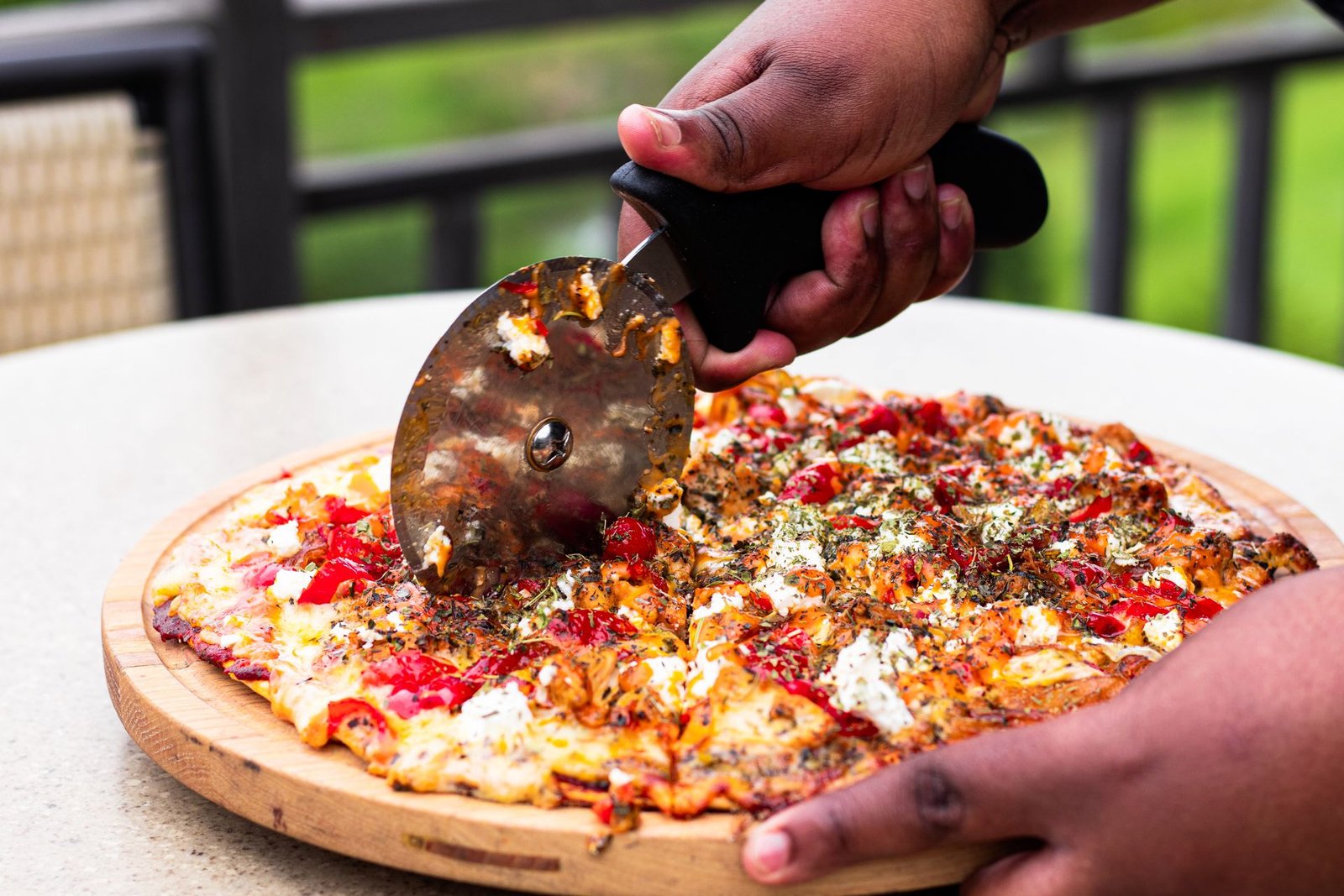
The rolling wheel is the icon: a circular blade on a handle that you roll across the pizza. Its strengths are familiarity and maneuverability — it navigates curves easily, making it ideal for round pizzas cut into traditional wedges. A good wheel with a large (around 4-inch), sharp blade glides through a standard crust in one pass. Its weaknesses show on extremes: on very thin, crispy crusts it can crack rather than cut, and on thick or heavily loaded pizzas (deep-dish, stuffed crust) it tends to compress and drag rather than slice cleanly. Most people’s bad experiences come from small, dull wheels — the freebie kind — which are barely better than tearing by hand. A quality wheel is a different animal entirely.
The rocker (or mezzaluna) is a curved blade with handles on each end that you press straight down and rock. This is the professional pizzeria workhorse for a reason: the downward pressing motion cuts through thick crusts, crispy cracker-thin bases, and mountainous toppings without any dragging or displacement. Because you’re pressing rather than rolling, nothing shifts — cheese stays put, toppings stay where you placed them. It’s unmatched for Chicago deep-dish, Sicilian, Detroit-style, and any pizza where a wheel would struggle. The trade-off is maneuverability: rockers cut in straight lines, so they’re less natural for wedge cuts on round pizzas (though entirely doable), and they need more storage space.
Kitchen shears / pizza scissors are the dark horse that converts skeptics fast. A sturdy pair of kitchen shears cuts pizza with surgical cleanliness — snip, snip, done — handling thick crusts, heavy toppings, and even stuffed edges without compressing anything. They’re especially brilliant for party-cut (square-cut) pizzas and for portioning slices for kids. The only real downsides: they’re slower for a whole large pizza than a wheel or rocker, and cutting on certain boards can dull them over time. If you own exactly one pizza-cutting tool and make varied styles, shears are arguably the most versatile choice. Many serious home bakers eventually own all three, reaching for each where it shines — which, if you’re building out your kit, pairs naturally with the broader roundup of essential pizza-making tools.
What Separates a Great Wheel From a Drawer-Clutter Wheel
If you’re buying a rolling wheel — still the right call for classic round pizzas — the details matter enormously. Blade size is first: look for a blade around 4 inches in diameter. Small 2-inch wheels look cute and cut terribly, requiring multiple passes that drag cheese. A large blade covers more distance per roll and powers through crust in one confident pass. Blade material should be stainless steel — it resists corrosion, holds an edge reasonably, and won’t react with acidic tomato sauce the way carbon steel can.
The handle is where cheap wheels betray you. You want a full, comfortable grip that keeps your knuckles clear of the pizza — the classic ergonomic pistol-grip or a long straight handle both work, as long as your hand sits high and secure. Avoid tiny stub handles that force your fingers near the blade path, and be wary of all-metal handles that get slippery with greasy hands; a textured or soft-grip handle is worth seeking out. A blade guard or cover matters more than you’d think: a razor-sharp 4-inch disc rattling loose in a drawer is a hazard, and a guard also protects the edge from chipping against other utensils.
Finally, consider construction and cleaning. A wheel that disassembles (or at least has an open, accessible axle area) is far easier to clean than a sealed unit where cheese cement migrates into the mechanism and seizes the blade. Dishwasher-safe is nice, but hand-washing and immediate drying keeps any blade sharper longer. Expect to pay more than the bargain-bin price — the jump from a $5 wheel to a $20 wheel is one of the biggest quality-per-dollar upgrades in all of pizza equipment.
Servers, Boards, and the Rest of the Slicing Setup
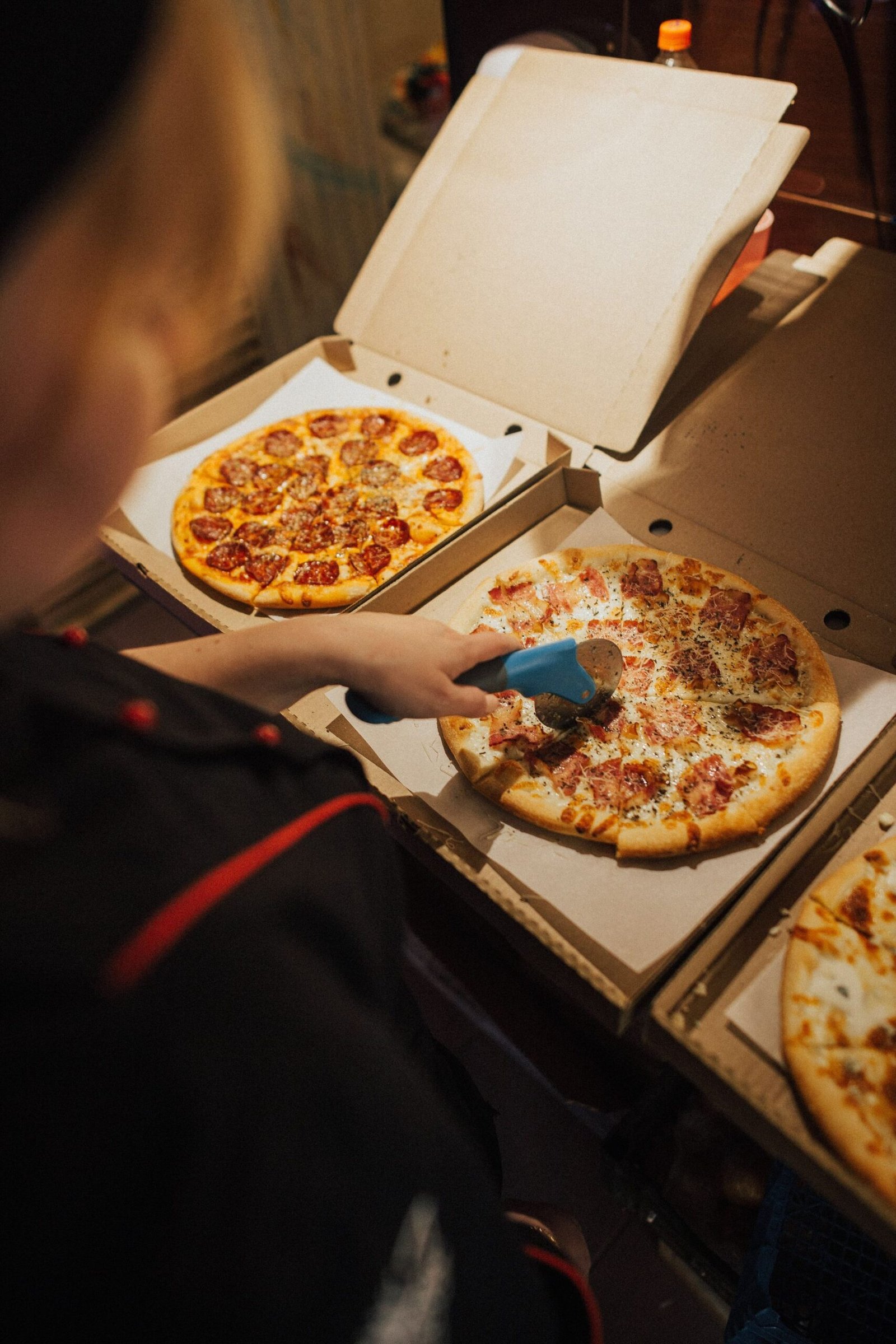
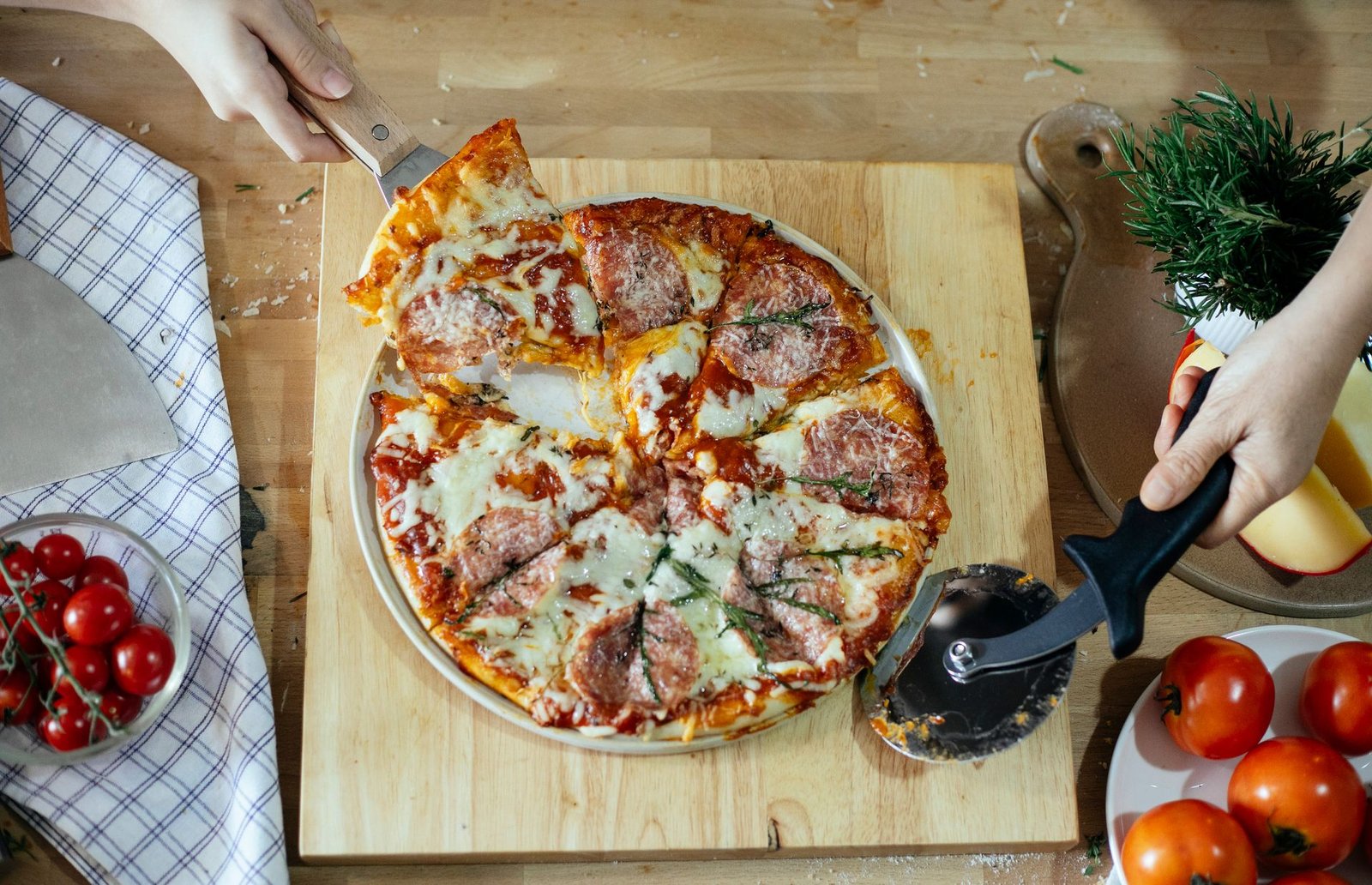
Cutting is only half the serving equation — getting intact slices from the cutting board to the plate is where pizzas fall apart, literally. A proper pizza server (sometimes called a pizza spatula) is wide, thin, and slightly flexible, designed to slide fully under a slice and support it. The flimsy slotted turner from your general kitchen drawer is not a pizza server: it’s too narrow, too thick at the edge, and it will fold your slice in half. A server with a beveled front edge slides under crust without bulldozing toppings, and a long handle keeps your hands clear of hot cheese. For serving a crowd, two servers are better than one — they let you lift from both sides on wide slices.
Your cutting surface matters too. Always cut on a wooden or plastic cutting board, never directly on your pizza stone or steel — blades scar and degrade the baking surface, and a dulled stone is a worse stone. A large round wooden board (often sold as a pizza board or serving peel) doubles as a rustic serving platter: cut on it, carry it to the table, done. For party-cut square slices, a big rectangular board gives you the straight edges to work against. And here’s a pro habit: slide the pizza off the peel onto the board before cutting, rather than cutting on the peel — peels are launching tools, and cutting on them dulls both blade and peel.
A few genuinely useful extras: a pastry wheel or fluted cutter for decorative edges on flatbreads and dessert pizzas; parchment or a silicone mat under the pizza if your board tends to stick; and for the obsessed, a pizza-cutting guide (a frame that portions even slices) — overkill for home use, but a fun gift for the pizza-obsessed. What you don’t need: electric pizza cutters, which solve a problem nobody has, and novelty cutters shaped like bicycles, which cut like novelties.
One more serving consideration for parties: when you’re putting out multiple pizzas, designate one board per pizza and let each rest on its own board rather than stacking cut slices. Stacking traps steam and softens crusts within minutes — the bottom pizza in a stack always suffers. If oven space allows, you can hold a baked pizza at very low oven heat (around 200°F) on a rack while you bake the next, then cut and serve each one fresh in sequence.
How to Cut Pizza Like a Pro
Technique matters as much as tools, and the pros follow a short, strict protocol. Step one: wait. Let the pizza rest 1 to 2 minutes after it leaves the oven. This isn’t optional fussiness — the cheese needs a moment to set, and cutting immediately is the number one cause of the cheese-slide avalanche. The crust also finishes crisping as surface steam escapes. Two minutes of patience transforms the cut.
Step two: commit to the cut. Whether wheel or rocker, the motion is firm, decisive, and single-pass. Position the blade, press down with authority, and roll or rock through in one motion. Sawing back and forth is what drags cheese and shreds crust — it’s the hallmark of a dull blade or a hesitant hand. If the blade won’t go through in one pass, the blade is the problem (sharpen or replace it), not your technique. For rockers, center the blade over the cut line and rock from one end to the other; for wheels, start at the far edge and roll toward yourself with steady pressure.
Step three: cut to the style. The classic pie cut (6 or 8 wedges) suits round Neapolitan, New York, and most homemade pizzas — cut through the center, rotating the board between cuts for even wedges. The party cut (grid of squares, also called tavern cut) is traditional for thin-crust tavern-style pizza and brilliant for gatherings: more pieces, easier sharing, and the crispy edge-to-center ratio that thin-crust lovers crave. For rectangular Sicilian or Detroit-style, straight parallel cuts into squares or strips are the natural choice. And for deep-dish, cut decisively with a rocker or serrated knife — then serve with a server under every slice, because gravity is not your friend with two inches of cheese.
Step four: serve immediately. Cut pizza cools fast and the crust starts softening under the toppings within minutes. Have plates ready, serve hot, and if you’re cutting multiple pizzas for a party, cut each one right before it goes out rather than pre-cutting everything. Our pizza party hosting guide has the full timing choreography for serving a crowd without the sad, steamed pile.
Best Pizza Cutter for Every Pizza Style: A Quick-Match Guide
Still unsure which cutter to buy first? Match the tool to the pizza you make most often — that’s the whole decision.
Neapolitan and soft, puffy crusts: A large rolling wheel is ideal. The crust is tender and the toppings are light, so a wheel glides through in one pass without compressing the airy cornicione. Pressing down hard with a rocker can actually deflate that prized puff, so the wheel’s rolling motion is gentler here. Let the pie rest the full two minutes — Neapolitan centers are soft, and premature cutting floods the plate.
New York–style and classic homemade rounds: The wheel’s home turf. A foldable, medium-thickness crust with moderate toppings is exactly what the rolling wheel was designed for. One confident roll per cut, pie-cut into 6 or 8 wedges, and you’re done. This is the scenario where a quality wheel most visibly outperforms a cheap one.
Thin, crispy, cracker-style crusts: Reach for the rocker. Thin crusts crack and shatter under a rolling wheel’s lateral pressure, but a rocker’s straight-down press snaps them cleanly. This is also where the party cut shines — the grid of squares gives you those coveted crunchy edge pieces, a tradition rooted in tavern-style pizza culture.
Deep-dish, stuffed, and Sicilian: Rocker, no contest — or a long serrated bread knife in a pinch. Two inches of cheese and a buttery, biscuit-like crust laugh at rolling wheels. The rocker’s full-length downward force is the only thing that cuts cleanly without dragging half the cheese with it. Cut deep-dish into wedges while it’s still in the pan for the cleanest result, then lift each slice with a wide server.
Detroit-style and pan pizzas: Another rocker win. The crispy cheese crown (the frico edge) shatters beautifully under direct downward pressure but tears under a wheel. Cut into squares — the rectangular pan demands it — and don’t skimp on the pressure.
Dessert pizzas and flatbreads: Kitchen shears or a fluted pastry wheel. Dessert pizzas with delicate toppings (fruit, chocolate drizzle, powdered sugar) cut most cleanly with shears, which don’t smear anything. A fluted wheel adds a decorative crimped edge that looks genuinely professional on sweet pies.
If you bake across all these styles — and many home pizzaiolos do — the practical answer is a wheel plus a rocker, with shears as the affordable third. Bought once and cared for, that trio handles literally any pizza you’ll ever make.
Care and Maintenance: Keeping Blades Performing
Pizza cutters are low-maintenance, but “low” isn’t “none.” Wash after every use — dried cheese cement is the enemy of every blade type, gumming up wheel axles and dulling edges. Hot water, dish soap, and a sponge handle it; for wheels, pay attention to the axle area where gunk hides. Dry immediately and completely, especially rockers and shears with any carbon-steel components, to prevent rust spots.
Sharpening is where expectations need calibrating. Rolling wheels are notoriously difficult to sharpen well at home — the curved edge defeats most pull-through sharpeners. A honing rod used carefully at the blade’s angle can refresh a wheel, but honestly, a quality wheel holds its edge for a very long time with normal home use, and replacement is reasonable when it finally dulls. Rocker blades, being essentially large curved knives, respond well to a whetstone or professional sharpening — treat them like the fine blades they are. Kitchen shears can be sharpened like scissors or replaced cheaply.
Storage deserves a thought: blade guards on wheels, blade covers or sheaths on rockers, and shears stored closed or in a sheath. A sharp blade banging around a drawer dulls itself and endangers fingers — the guard protects both. Know when to retire a blade, too: a rocker that’s been sharpened so many times the curve is visibly flattened, a wheel with a wobbling axle that can’t be tightened, or any blade with chips or pitting that snag on crust. With this minimal care, a good cutter set lasts years; the best pizza cutter is ultimately the one that’s sharp, clean, and within reach when the pizza comes out.
Frequently Asked Questions
What is the best pizza cutter for home use?
For classic round pizzas, a large (4-inch) rolling wheel with a comfortable handle is the best all-rounder. For thick, crispy, or heavily loaded pizzas, a rocker (mezzaluna) blade cuts cleaner. Kitchen shears are the most versatile single tool across styles. Many enthusiasts own a wheel plus shears and cover every scenario.
Are pizza rocker cutters better than wheel cutters?
They’re better for specific jobs: thick crusts, cracker-thin crispy bases, deep-dish, and loaded pizzas, where the straight-down pressing motion cuts without dragging. Wheels are better for maneuverability and classic wedge cuts on standard pizzas. Neither is universally superior — it depends on what you bake most.
Can I use kitchen scissors to cut pizza?
Absolutely — sturdy kitchen shears are one of the cleanest ways to cut pizza, especially through heavy toppings and thick crusts. Use a pair reserved for food, wash and dry them after use, and avoid cutting on surfaces (like ceramic plates) that will dull them quickly.
How do I keep my pizza cutter from dragging the cheese?
Three fixes: let the pizza rest 1–2 minutes so the cheese sets; use a sharp blade (dull blades drag); and cut with firm, single-pass pressure instead of sawing. Overloaded, extra-cheesy pizzas will always be harder — a rocker or shears handles those best.
Should I cut pizza on the stone or a cutting board?
Always a cutting board. Cutting on your stone or steel scars the baking surface and dulls your blade. Slide the pizza onto a wooden or plastic board first — a big round board can go straight to the table as a serving platter.
How often should I replace a pizza wheel?
A quality stainless wheel lasts years in home use. Replace it when it no longer cuts cleanly in one pass despite cleaning — persistent dragging, tearing, or a wobbly/seized axle are the signs. Cheap wheels may need replacing yearly; good ones rarely do.
Conclusion
The best pizza cutter isn’t a mystery — it’s the right blade for your pizza, kept sharp and used with confidence. A quality wheel for your classic rounds, a rocker for the thick and crispy, shears for everything in between, and a real server to get slices to the plate intact. Add the pro technique — rest, commit, cut to the style, serve hot — and the last thirty seconds of your bake will finally do the first twenty minutes justice. It’s a small corner of pizza-making, but it’s the corner your guests actually see and touch every single time. For the rest of your pizza toolkit, explore our ovens and equipment guides.