

A pizza turning peel is the small, round metal disc on a long handle that pizzaiolos use to rotate a pizza inside a blazing-hot oven without pulling it out. If you’ve ever watched a Neapolitan pizza bake in 90 seconds and wondered how the cook keeps the crust from scorching on the flame side while the far side stays pale, this unassuming tool is the answer. It slides under the pizza mid-bake, lifts it a fraction of an inch, and spins it — giving every edge equal time facing the heat.
Most home pizza makers already own a launching peel, the wide flat paddle that carries a raw pizza into the oven. Our guide to using a pizza peel covers that tool in depth. But once the pizza is on the hot deck, the launching peel is too big and clumsy for a tight, 900°F chamber. That’s the gap the turning peel fills, and it’s the biggest difference between pizzas that come out evenly leopard-spotted and pizzas that burn on one side while staying undercooked on the other.
This guide covers what a turning peel is and how it differs from the peel you already own, the quarter-turn technique professionals use, how to rotate a delicate pizza without tearing it, which sizes and materials to buy, and the mistakes that undo good dough work in the final ninety seconds.
🍕 Key Takeaways
- A pizza turning peel is a small round disc (usually 7–9 inches) on a long handle, designed to rotate pizza inside a hot oven mid-bake.
- It differs from a launching peel: the launcher is wide and flat for loading raw pizza; the turner is small and nimble for spinning baked pizza.
- Rotate the pizza a quarter turn every 20–30 seconds in a hot oven so every side gets equal exposure to the flame and hot spots.
- Slide the disc fully under the pizza and lift slightly before turning — never drag or twist against the deck, or the crust will tear.
- Choose a head smaller than your pizzas, a handle long enough to reach the back of your oven, and aluminum or stainless steel construction.
- The turning peel also rescues pizzas: it lifts stuck spots, shields crust from direct flame, and checks the underside for doneness.
What Is a Pizza Turning Peel?
A pizza turning peel is almost comically simple: a flat, round metal disc — typically 7 to 9 inches across — mounted at a slight angle on a long, slim handle anywhere from 24 inches to 5 feet. No moving parts, no settings. You slide the disc under a baking pizza, lift it just off the oven floor, and rotate it. That single motion stands between you and a pizza that’s charred on the flame side and floppy on the far side.
The disc is deliberately small. A launching peel needs a big blade to support a full raw pizza and its toppings in one trip. A turning peel only supports the pizza’s center of gravity for the second or two it takes to spin it. That small head is what makes it maneuverable: in a compact outdoor pizza oven barely wider than the pizza itself, there’s no room to swing a full-size peel around. The turning peel’s slim profile slips into gaps the launching peel can’t reach — which is why professionals in Naples have used them for generations, long before home pizza ovens made them a backyard essential.
The slight angle where disc meets handle matters more than it looks. It keeps the disc flat against the oven floor while your hand stays above the heat, and gives leverage to lift the pizza’s edge with a flick of the wrist. Cheap turning peels sometimes mount the disc dead flat on a straight handle, forcing you to angle your whole arm awkwardly. When shopping, look for that gentle bend — it’s the difference between a tool that feels like an extension of your hand and one that fights you.
Why Your Pizza Burns Without a Pizza Turning Peel
No oven heats perfectly evenly, and pizza ovens are the least even of all. In a wood-fired or gas pizza oven, the flame lives on one side or at the back, and radiant heat pours off the dome in an uneven wash. The side of the pizza facing the flame can be far hotter than the side facing the door. Our pizza oven temperature guide breaks down these heat zones in detail, but the practical consequence is simple: a pizza left in one position will always burn on one side before the other side finishes.
This is why Neapolitan pizzas bake in about 90 seconds yet need attention the entire time. At 850–900°F, the difference between beautifully charred and genuinely burnt is measured in seconds, and it’s always the flame-facing edge that crosses the line first. Without a turning peel, your options are bad: reach in with tongs and risk tearing the crust, pull the whole pizza out to reposition it and lose heat, or just accept the scorch.
A turning peel makes rotation trivial. Every 20 to 30 seconds, slide the disc under the pizza, lift, and give it a quarter turn. Each edge takes its turn facing the flame, then rotates away before it can burn. The result is the even, leopard-spotted crust you see in pizzerias — not because their ovens are magically even, but because someone is actively managing the bake. The tool doesn’t just prevent burning; it gives you control over browning, letting you park the palest section near the flame for extra seconds or shield a section that’s coloring too fast.
Home ovens have the same problem in miniature. A pizza steel in a home oven at full blast still has hot spots — usually at the back near the broiler element. The turning peel works there too, with a shorter handle and less frequent rotation, maybe once or twice during a 5–7 minute bake. The principle never changes: even heat is something you create with movement, not something you wait for the oven to provide.
How to Use a Turning Peel: The Technique
Technique matters more than the tool itself. A good turning peel in clumsy hands still tears crusts; a cheap one in practiced hands turns out beautiful pizzas.
The quarter-turn method
Wait until the pizza has set — usually 20 to 30 seconds into the bake in a hot pizza oven, or 2 to 3 minutes in a home oven. The crust needs enough structure to hold together when lifted; turn too early and you’ll fold a floppy disc of raw dough. It’s ready when the edge facing the flame shows its first spots of color.
Slide the turning peel in flat along the oven floor, approaching from the side opposite the flame. Get the disc fully under the pizza’s center — not just under the edge. This is the most common beginner error: catching only the rim and spinning folds the pizza like a taco. The disc should disappear underneath so the whole pie rests on metal. Lift slightly — just a quarter inch, enough to break contact with the deck — rotate your wrist 90 degrees, and set it back down gently. That’s one turn. Repeat every 20 to 30 seconds until done.
Rotating without tearing the crust
Tearing has two causes: lifting before the disc is fully underneath, and twisting while the crust is stuck to the deck. Prevent the first by checking that no metal peeks out from under the pizza’s near edge — if you can see the disc, it’s not far enough in. Prevent the second by always lifting before rotating. The motion is lift, then turn, then lower — three distinct beats, never a grind. If the pizza resists the initial slide, work the disc’s edge gently under the stuck spot with a slight sawing motion rather than forcing it.
Wet dough tears more easily than properly floured dough, which is why upstream dough work matters. A pizza built on a well-floured launching peel with balanced hydration releases cleanly and turns without drama. If you’re consistently tearing pizzas mid-turn, the culprit is often too much sauce or toppings weighing down a wet center.
Reading the bake while you turn
Each turn is also an inspection. As you lift, glance at the underside: you want even golden-brown with darker spots — not pale blonde (needs more time) and not blackened patches (too hot, or burnt flour on the deck). An infrared thermometer earns its keep between turns — a quick deck reading tells you whether a pale bottom means “needs more time” or “the floor lost heat.” Professionals check the underside on nearly every turn; make it a habit.
The turning peel also doubles as a flame shield. If one section colors much faster than the rest, hold the disc vertically between the flame and that section for a few seconds — a technique called “doming” when done overhead to finish the top. It buys slower sections time to catch up. This active bake management is what separates good home pizza from pizzeria pizza, and it’s only possible with a tool you can maneuver precisely inside the chamber.
Choosing a Turning Peel: Sizes and Materials
Head size: smaller than your pizzas
Turning peel heads typically run 7, 8, or 9 inches in diameter. The rule is simple: the head should be clearly smaller than the pizzas you bake. A 7-inch head suits 10–12 inch Neapolitan pizzas — nimble and light. An 8-inch head suits 12–14 inch pizzas and is the most versatile all-rounder. A 9-inch head handles 14–16 inch New York-style pies but loses maneuverability in compact ovens. When in doubt, go smaller: you can turn a big pizza with a small disc by lifting from the center, but you can’t maneuver an oversized disc in a tight chamber.
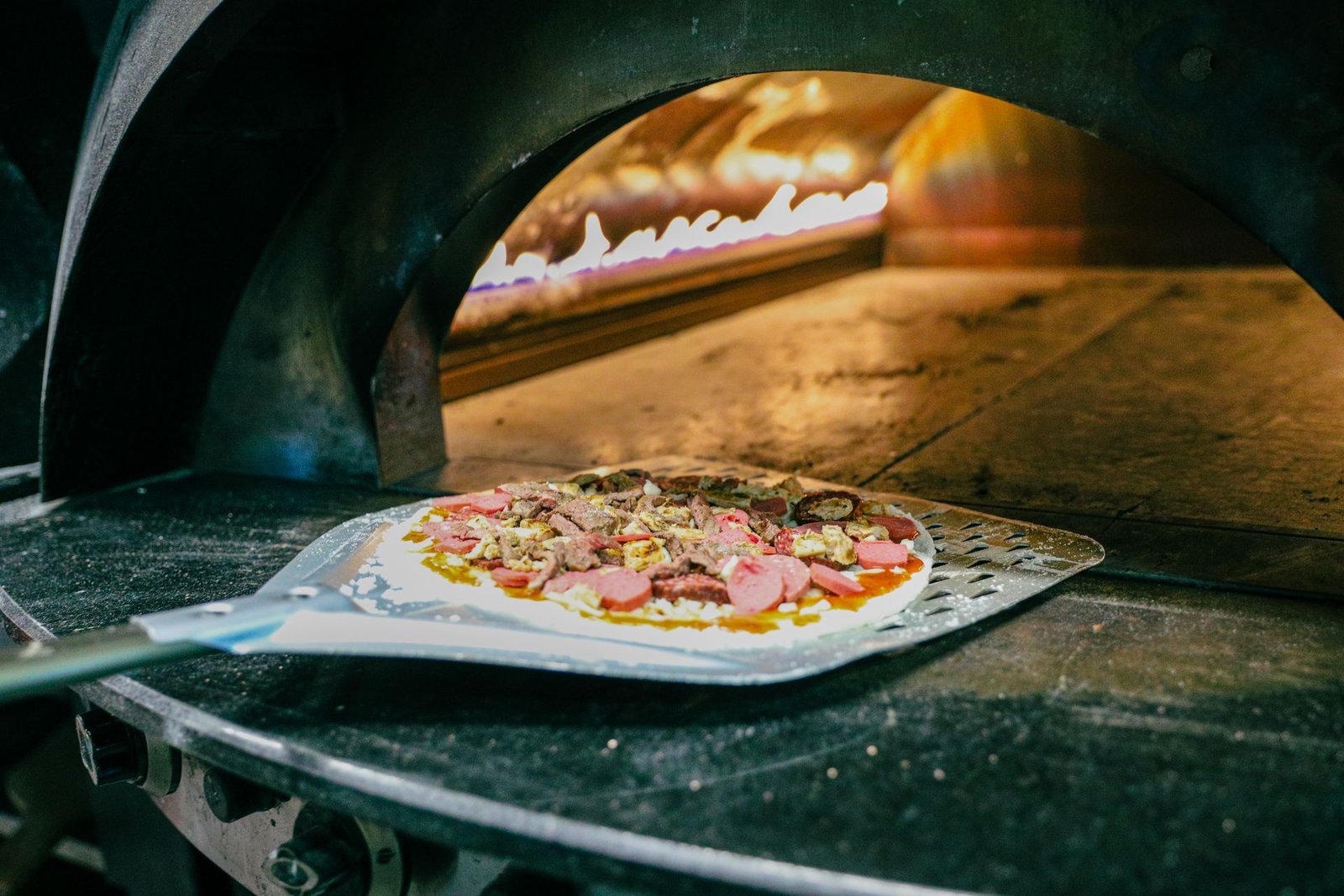
Perforated heads — discs with small holes punched through — are worth seeking out. The holes let excess flour fall through instead of burning on the deck (burnt flour makes bitter black spots), and they reduce the contact area that can make a pizza stick to the peel. Most quality turning peels are perforated now; given the choice, take the perforated one.
Handle length: match your oven depth
For compact outdoor pizza ovens (the 12–16 inch class), a 24–30 inch handle is plenty — long enough to reach the back while your hand stays clear of the opening’s heat. For larger wood-fired ovens, 36–48 inch handles let you work the full depth without leaning into the oven mouth. For home-oven use with a pizza steel, a short 8–12 inch handle is actually easier to control than a full-length peel. Longer isn’t automatically better: an overlong handle in a small oven is clumsy and imprecise. Measure your oven’s depth from mouth to back wall, then add about 12 inches — that’s your ideal handle length.
Materials: aluminum vs stainless steel
Most turning peels use an aluminum head — light, quick to shed heat, and rust-proof. Hard-anodized aluminum is the sweet spot: tougher surface, still lightweight. Stainless steel heads are heavier but nearly indestructible and won’t warp under brutal wood-fired heat; they’re the choice for high-volume or commercial use. Avoid plastic or wooden components near the head — they’ll scorch in a real pizza oven. Whatever you choose, the head should feel rigid, not floppy — a flexing disc is hard to slide flat under a pizza.
Turning Peel vs Launching Peel: When to Use Each
These two tools are a pair. The launching peel — wide, flat, rectangular — does one job: carrying the raw, topped pizza from your work surface into the oven in a single confident motion. Its size is its virtue at launch time and its curse afterward. Once the pizza is baking, that big blade can’t maneuver in a hot, tight chamber without bulldozing the pizza.
The turning peel takes over the moment the pizza hits the deck. Small head, long handle, built for precision movement inside the heat. You’ll use the launcher once per pizza and the turner four to six times per pizza — which says a lot about which tool shapes the final result. Many beginners buy an expensive launching peel and skip the turning peel, then wonder why their pizzas burn. The experienced move is the reverse: a serviceable launcher plus a good turner beats a premium launcher with no turner every time.
Mistakes That Tear Crusts and Ruin Bakes
Turning too early. The number-one beginner mistake. A pizza that’s been on the deck for ten seconds is still essentially raw dough — lifting it folds it and slides the toppings. Wait for the structure to set: about 20–30 seconds at 900°F, when the crust starts to puff and the cheese begins to melt.
Catching only the edge. Sliding the disc under just the rim and twisting folds and tears the pizza. Get the disc fully under the center before lifting. If the approach angle is awkward, come in from the side rather than straight on.
Twisting against the deck. Rotation happens in the air, not against the oven floor. Lift first, then turn. Grinding the pizza against the deck while twisting drags and tears the still-soft dough. Three beats: lift, turn, lower.
Over-turning. Each lift risks disturbing the pizza. In a moderately hot oven (550–650°F), turning every 20 seconds is unnecessary handling. Match cadence to heat: every 20–30 seconds at 850°F+, every 60–90 seconds at 600–700°F, once or twice total in a home oven.
Forgetting the underside. Rotate religiously but never check the bottom, and you’ll discover a pale, floppy — or burnt — underside at serving time. Every second or third turn, tilt the pizza on the disc and look underneath. The bottom should track the top’s progress.
Leaving the peel in the oven. A metal turning peel left inside a hot oven between pizzas becomes too hot to handle and can warp. Rest it on a heat-safe surface outside the oven mouth between turns.
Caring for Your Turning Peel
After each session, let the peel cool completely, then wipe the disc with a damp cloth to remove flour and cheese drips. Don’t soak aluminum heads for long periods, and never put a wooden-handled peel in the dishwasher. Baked-on cheese comes off with a plastic scraper and a baking soda paste. Hang the peel by its handle hole or lean it where the disc won’t bend — a bent disc won’t sit flat on the oven floor. Check the rivets or welds where head meets handle once a season; that’s the stress point, and a loose head is a pizza-dropping accident waiting to happen. A quality turning peel lasts years of weekly pizza nights, making it one of the best value upgrades in the ovens and equipment category.
Frequently Asked Questions
Do I really need a turning peel, or can I use tongs?
Tongs are the most common substitute and the most damaging. They grip by pinching, which compresses and tears the puffed crust, and they drag the pizza rather than lifting and spinning it. A turning peel lifts from underneath, supporting the weight evenly, and rotates in one smooth motion.
What’s the difference between a turning peel and a small pizza peel?
Retailers blur the terms: some “small peels” are just scaled-down launching peels with rectangular blades meant for loading. A true turning peel has a round disc head, usually perforated, mounted at an angle on a long slim handle. The round shape allows smooth rotation — a rectangular blade catches and drags when you spin.
When should I make the first turn?
When the crust has set enough to hold its shape — about 20–30 seconds at 850–900°F, 60–90 seconds at 650–750°F, or 2–3 minutes in a home oven at 550°F. Trust visual cues over the clock: the flame-facing edge should show first color, the crust should puff, and the cheese should be melting. If the pizza feels floppy and fragile when you slide under, give it another 15–20 seconds.
Can I use a turning peel in a regular home oven?
Yes, with a shorter handle. A full-length peel is unwieldy in a home oven — you’ll bang the handle on the door and lose fine control. Look for a short 8–12 inch turning peel or small offset turner. The technique is identical, and you’ll only need one or two turns per bake — but they still even out hot spots, especially the common hot zone at the back near the heating element.
Why does my pizza stick to the turning peel?
Usually old cheese residue on the disc, a wet bottom from excess sauce or very high hydration dough, or hesitating mid-lift while hot cheese bonds to the metal. Keep the disc clean and dry, dust it very lightly with flour or semolina if sticking recurs, and commit to the motion — slide, lift, turn in one confident sequence. A perforated head helps too, with less metal surface to grab.
Is a turning peel useful for anything besides pizza?
Yes. It’s excellent for maneuvering flatbreads, pita, and naan in a hot oven, rotating sheet-pan items without pulling the pan out, and lifting focaccia off a hot steel. But pizza is its native purpose — size, shape, and handle length are all optimized for spinning a 10–16 inch disc of dough in intense heat — and that’s where it earns its place.
Conclusion: The Quiet Tool Behind Even Bakes
The pizza turning peel will never be the most exciting tool in your setup. It doesn’t launch the pizza with a flourish or measure temperatures. But bake after bake, it’s the tool that stands between your dough work and the result you wanted — the difference between a pizza that’s evenly blistered all the way around and one that’s scorched on the flame side while the far side stays pale.
If you’re baking in a real pizza oven at 750°F or above, a pizza turning peel belongs in your kit alongside your launching peel — not as an accessory but as the second half of the pair. Learn the quarter-turn rhythm, slide fully under before you lift, check the underside as you go, and match the tool’s size to your oven.