

How long to preheat pizza steel is the most underestimated question in home pizza making. Most people heat their oven until the “ready” beep, slide a pizza onto a steel that’s been inside for 15 minutes, and wonder why the crust comes out pale and floppy while the cheese is done. The answer: a pizza steel needs 45–60 minutes at full blast to fully saturate with heat — and a pizza stone needs about the same. The oven air heats in 15 minutes; the thermal mass you’re actually baking on takes three to four times longer.
This matters because your pizza cooks from two directions at once. The top cooks from the oven’s hot air and radiant heat; the bottom cooks almost entirely from direct contact with the steel or stone. If that surface isn’t fully heated through, the bottom can’t keep up — you get the classic home-pizza failure of a done top and an underdone, soggy base. No amount of broiler trickery fixes a cold baking surface. Preheating isn’t a suggestion; it’s the foundation the whole bake stands on.
This guide explains why thermal mass needs so much time, the exact preheating times for pizza steels and stones by thickness, how to tell when your surface is truly ready, the full home-oven preheating method, and the mistakes that leave your steel half-heated. If you’re still deciding between the two surfaces, our pizza steel vs pizza stone comparison breaks down the trade-offs first.
🍕 Key Takeaways
- Preheat a pizza steel for 45–60 minutes at your oven’s maximum temperature — the oven’s “ready” beep at 15 minutes means the air is hot, not the steel.
- Preheat a pizza stone for 45–60 minutes too; thinner stones (½ inch or less) may be ready closer to 40 minutes, thicker stones need the full hour.
- The bottom of your pizza cooks by contact with the surface — an under-heated steel or stone is the top cause of pale, soggy crusts.
- An infrared thermometer is the only reliable way to confirm readiness: look for 500–550°F+ on the surface in a home oven.
- Place the steel or stone in a cold oven and heat everything together — never put a cold stone into a screaming-hot oven.
- Between pizzas, give the surface 5–10 minutes to recover heat before launching the next one.
Why Thermal Mass Takes So Long to Heat
A pizza steel is a slab of steel — typically ¼ to ½ inch thick and weighing 15–30 pounds. A pizza stone is a slab of cordierite or ceramic of similar heft. Heating that much dense material through takes time because heat moves through it by conduction, layer by layer, from the outside in. Your oven’s heating element warms the air in 10–15 minutes, and that hot air then has to pump heat into the slab’s surface, which conducts it slowly toward the core. The surface might read 400°F while the center is still at 200°F — and a surface with a cold core behind it sheds its heat the moment a room-temperature pizza lands on it.
This is the physics behind “heat saturation.” A fully saturated steel or stone holds enough stored energy to blast the pizza’s underside with intense, sustained heat for the entire bake — that’s what creates the crisp, leopard-spotted bottom crust. A partially heated slab gives up its surface heat in the first minute and then has nothing left; the crust steams instead of searing, and you get the dreaded soggy bottom. The difference between a 20-minute preheat and a 50-minute preheat isn’t subtle — it’s often the entire difference between mediocre and excellent pizza.
Steel heats faster than stone because steel conducts heat roughly 10–20 times better than ceramic, which is why steels have become the home-oven favorite. But “faster” still means 45–60 minutes for full saturation at home-oven temperatures — steel’s advantage shows in recovery time between pizzas and in the intensity of the bottom heat, not in a dramatically shorter preheat. Don’t let steel’s reputation for performance tempt you into shortchanging the preheat; the physics of heating 20 pounds of metal doesn’t care about marketing.
How Long to Preheat Pizza Steel: Times by Thickness
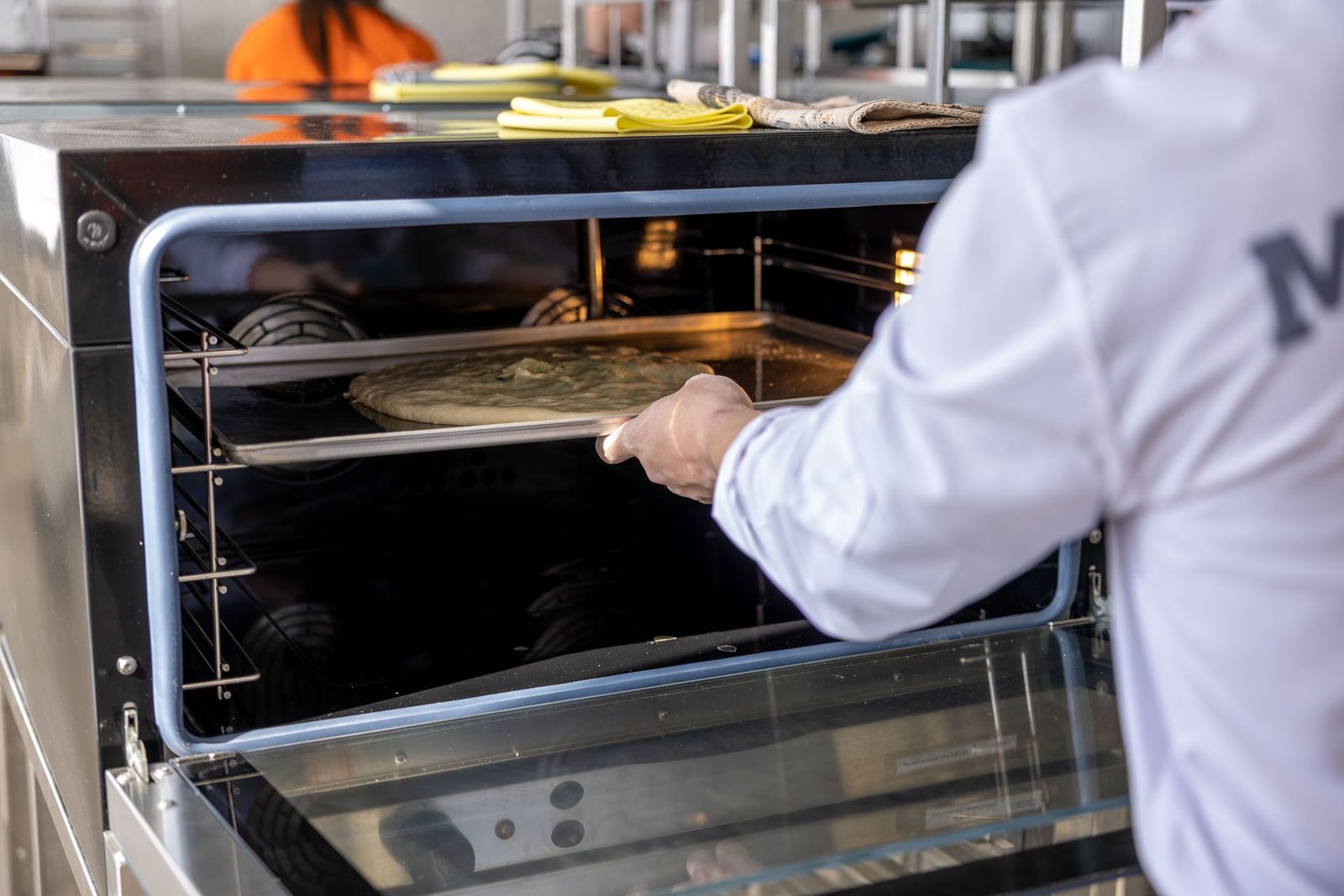
For the standard home pizza steel — ¼ inch thick (the most common) — preheat for a full 45–60 minutes at your oven’s highest temperature, typically 500–550°F. Start timing when you turn the oven on, not when it beeps ready. The beep means the air hit the target; the steel is just getting started. At 45 minutes a ¼-inch steel is usually well saturated; give it the full 60 when your oven runs cool, when you’re baking multiple pizzas, or when the kitchen is cold.
Thicker steels need more time. A ⅜-inch steel — popular with serious home bakers for its extra thermal punch — wants 60–75 minutes for full saturation. A ½-inch steel, the heavyweight option, can need 75–90 minutes. The thicker the steel, the more heat it stores and the better it performs — but only if you actually give it the time to charge. An under-preheated thick steel performs worse than a fully preheated thin one, because you’re carrying all that weight for none of the benefit.
Position matters too. Place the steel on a rack in the upper third of the oven — close enough to the broiler to get radiant top heat on the pizza, with room above for the pizza to launch. The steel goes into a cold oven before you start preheating, so it heats gradually along with everything else. This protects the steel (no thermal shock concerns with steel, but gradual heating is still gentler on your oven) and means you never have to handle a 500°F slab.
How Long to Preheat a Pizza Stone
Pizza stones follow the same 45–60 minute rule, with thickness as the main variable. A standard ½–¾ inch cordierite stone needs the full 45–60 minutes at maximum oven temperature. Thinner stones — ⅜ inch or less, common in budget options — may saturate closer to 35–45 minutes, but they’re also more fragile and more prone to cracking from thermal stress, so don’t rush them deliberately.
The critical stone-specific rule: always put the stone in a cold oven and heat it together with the oven. Placing a cold stone into a preheated 550°F oven is the classic way to crack it — the outside expands faster than the inside, and cordierite, for all its heat tolerance, can’t handle that gradient. This is also why you should never run a pizza stone through a self-cleaning oven cycle or plunge a hot stone into water; thermal shock is the stone’s mortal enemy.
Stones also need longer recovery between pizzas than steels. Where a steel bounces back in 5 minutes, a stone may want 10–15 minutes between bakes to rebuild surface heat — ceramic gives up its heat more reluctantly and reabsorbs it more slowly. If you’re baking for a crowd on a stone, factor that recovery time into your rhythm, or the third and fourth pizzas will show progressively paler bottoms. This recovery gap is one of the main practical reasons bakers upgrade from stone to steel.
How to Tell When Your Steel or Stone Is Truly Ready
The oven beep lies — or rather, it tells a narrow truth about air temperature. The only reliable way to know your baking surface is ready is to measure the surface itself, and the tool for that is an infrared thermometer. Point it at the center of the steel or stone and read the surface temperature directly. In a home oven maxed at 500–550°F, you’re looking for a surface reading of at least 500°F, ideally 525–550°F, before the first launch. If it reads 425°F at the 30-minute mark, you have your answer: it’s not ready, and now you know exactly how much longer to wait.
Beyond the number, check for evenness. Take readings at the center, the edges, and the corners. A difference of 25–30°F across the surface is normal; a cold spot 75°F+ below the center means uneven heating — often from the steel sitting too close to the oven wall or a rack blocking airflow. You can rotate the steel 180° halfway through preheating to even things out, the same principle as rotating the pizza itself during the bake.
If you don’t own an infrared thermometer yet, the flour test is a rough backup: toss a pinch of flour onto the surface. If it browns within 10–15 seconds, the surface is in pizza territory; if it just sits there pale, keep waiting. It’s imprecise — flour browns across a wide range — but it beats guessing blind. That said, an infrared thermometer is one of the highest-value tools in pizza making, useful for deck temps, oven calibration, and pan work; the flour test is a stopgap, not a strategy.
The Full Home-Oven Preheating Method
Here’s the complete routine, start to finish. Place your steel or stone on a rack in the upper third of a completely cold oven. Set the oven to its maximum temperature — usually 500–550°F — and start a 60-minute timer. Not 20 minutes. Not “when it beeps.” Sixty minutes, during which you do your other prep: stretch dough, organize toppings, set up your launching station.
At the 45-minute mark, take your first surface reading with the infrared thermometer. If you’re at target temperature and readings are even, you can launch — but there’s no penalty for waiting the full hour. In fact, for the first pizza of the night, the full hour is the safer bet; the oven walls and racks contribute radiant heat too, and they’re still catching up at 45 minutes.
For the last 5–10 minutes of preheating, switch to the broiler if your oven allows it — this superheats the steel’s surface and the oven’s upper region, giving you extra top heat for the launch. Watch it closely; broilers can overshoot fast. Then switch back to bake mode (or leave the broiler on low, depending on your oven’s behavior — learn what yours does) and launch your first pizza.
Between pizzas, close the oven door and wait 5–10 minutes for a steel, 10–15 for a stone. The surface gave up a burst of stored heat to the pizza you just baked, and it needs a few minutes to rebuild. Use this time to stretch and top the next pizza — the rhythm of prep-then-bake naturally builds in recovery if you don’t rush it. Launching pizza number two onto a depleted surface is the most common reason the second pizza disappoints after a great first one.
Preheating in a Dedicated Pizza Oven
Outdoor pizza ovens — wood-fired or gas — play by faster rules because they run so much hotter. A gas pizza oven typically reaches baking temperature in 15–20 minutes; a wood-fired oven needs 30–60 minutes depending on size, insulation, and how cold it started. But the principle is identical: the deck (usually cordierite stone) must saturate, not just the air. Our pizza oven temperature guide covers target deck temps by style — roughly 650–750°F for New York style, 750–900°F for Neapolitan.
In a wood-fired oven, the deck heats from the fire built directly on it, then you push the fire aside and let the deck’s stored heat do the work. The tell that the deck is ready: the dome’s soot burns off white-hot (the oven “tells” you it’s ready by going clean), and an infrared reading of the deck center hits your target. In a gas oven, preheat with the flame on full, then take a deck reading — the stone saturates faster under direct flame, but still give it the full 15–20 minutes rather than trusting the air temperature.
One pizza-oven-specific note: the deck loses heat to every pizza faster than a home-oven steel does, because each bake is so intense. In a Neapolitan-speed bake, the deck can drop significantly after just two or three pizzas. Manage this by keeping a small live flame during baking (it reheats the deck between pizzas) and by giving the oven a few minutes of empty full-flame time if bottoms start coming out pale. Active deck management is part of the craft at these temperatures.
Preheating Mistakes That Ruin the Bake
Trusting the oven beep. The beep measures air temperature at the oven’s sensor, usually near the top. Your steel sits in a different thermal world. Every under-preheated pizza in history started with someone trusting the beep. Time the preheat with a clock — 45–60 minutes from when you turn the oven on — and verify with a surface reading.
Putting a cold stone in a hot oven. Thermal shock cracks stones. Stone always goes into a cold oven and heats with it. (Steel is immune to this — you can put a cold steel into a hot oven safely — but heating together is still simpler and easier on your oven.)
Opening the door constantly. Every peek dumps hot air and stalls the preheat. During the 60-minute preheat, leave the door shut. Take your surface readings quickly through a barely-opened door, or better, trust the timer for the first 45 minutes and measure once.
Skipping recovery between pizzas. The first pizza gets the fully charged surface; the second pizza gets what’s left. Five to ten minutes of closed-door recovery for steel (longer for stone) between launches keeps every pizza in the batch consistent. Plan your topping prep around this rhythm instead of fighting it.
Preheating with the broiler the whole time. Some guides suggest broiler-only preheating for maximum top heat. The problem: the broiler superheats the steel’s surface while the core and oven walls lag behind, giving you a surface that scorches the first pizza’s bottom and then fades. Full bake-mode preheat for saturation, broiler only as a finishing boost — that’s the reliable formula for great pizza from a home oven.

Frequently Asked Questions
Can I preheat a pizza steel too long?
Practically speaking, no. Once a steel reaches equilibrium with the oven — usually by 60–90 minutes depending on thickness — it just sits at oven temperature indefinitely. There’s no harm in a two-hour preheat beyond the energy cost. The real risk runs the other direction: almost everyone under-preheats, almost no one over-preheats. If your schedule means the steel sits at temperature for an extra 30 minutes while you finish prep, that’s fine — arguably ideal.
Why is my pizza steel not getting hot enough?
First, verify with an infrared thermometer — “not hot enough” is often “not preheated long enough.” If the surface genuinely won’t climb past 450°F after a full hour, check your oven’s actual temperature (many ovens run 25–50°F cool; an oven thermometer reveals this), make sure the steel isn’t blocked from the heating element by a solid pan or misplaced rack, and confirm you’re on the maximum setting rather than a preset “pizza mode” that caps lower. In an older oven, the heating element itself may be weakening.
Should I preheat with convection/fan mode on?
Convection helps heat the oven air faster and more evenly, which modestly speeds the steel’s preheat — but it doesn’t change the 45–60 minute requirement much, since conduction into the slab is the bottleneck, not air temperature. One caution: some ovens’ convection modes cap the maximum temperature lower than standard bake mode. If yours does, use standard bake at max temp for preheating. You can switch to convection for the bake itself if you prefer the browning it gives.
Does a thicker steel always make better pizza?
A thicker steel stores more heat and recovers faster between pizzas, which produces better bottoms during multi-pizza sessions — but only if you preheat it fully. A ½-inch steel given 30 minutes performs worse than a ¼-inch steel given 60. Thicker also means heavier (a ½-inch 16×16 steel approaches 30 pounds) and longer preheats. For most home bakers making 2–4 pizzas, a ¼-inch or ⅜-inch steel with a proper hour-long preheat is the sweet spot of performance and practicality.
Can I leave my pizza steel in the oven all the time?
Yes, and many bakers do — it acts as thermal mass that stabilizes the oven for all your baking, not just pizza. Two caveats: it adds significant preheat time to everyday baking (the oven now has 20 pounds of steel to heat for a batch of cookies), and it can interfere with dishes that need bottom heat blocked or precise rack positioning. If you bake daily, the convenience trade-off may not be worth it; if pizza night is weekly, leaving it in is perfectly fine.
How long should I preheat for frozen pizza on a steel?
Frozen pizza on a preheated steel is a genuine upgrade — the steel’s stored heat crisps the bottom far better than a bare rack. Preheat the full 45–60 minutes just as you would for fresh dough; the steel doesn’t know what’s landing on it, it just needs to be saturated. Launch the frozen pizza directly onto the hot steel (no thawing needed) and bake per the package directions, checking a few minutes early since the bottom cooks faster. Use a peel or the cardboard round to transfer — don’t reach in bare-handed.
Conclusion: Time Is the Ingredient You’re Skipping
How long to preheat pizza steel comes down to one number: 45–60 minutes at your oven’s maximum temperature, timed from the moment you turn the oven on. Stones want the same. That hour feels excessive until you understand what it’s doing — driving heat layer by layer into pounds of dense material until the whole slab is saturated and ready to sear. The oven beep at 15 minutes is measuring air; your pizza’s bottom crust is cooked by the surface, and the surface runs on its own slower clock.
Make the long preheat non-negotiable: steel in a cold oven, max temperature, 60-minute timer, verify with an infrared thermometer, recover between pizzas. It’s the least glamorous part of pizza night and the highest-leverage — more than any topping choice or dough trick, a fully saturated baking surface is what turns home pizza from “pretty good” into the real thing.