

Ask most people about Chicago pizza and they’ll picture deep dish — a casserole-like pie you eat with a knife and fork. But ask a Chicagoan what they actually eat on a Friday night, and you’ll hear about tavern style pizza: a cracker-thin, crispy crust with toppings spread edge to edge, cut into squares, built for sharing over beers. It’s the city’s everyday pizza, the one locals grew up on, and for decades it was Chicago’s best-kept secret from the rest of the country.
Tavern-style pizza is defined by extremes. The crust is rolled thin — almost cracker-like, with none of the puffy rim you’d find on a Neapolitan or New York pie. Toppings go all the way to the edge. The whole thing is cut into small squares (“party cut”), not wedges, so a group can graze. And it’s sturdy: engineered to stay crisp under toppings and to be eaten with one hand while holding a drink in the other. This guide covers the style’s barroom origins, what makes it distinct, the full recipe and technique, and how to nail that shattering crisp at home.
🍕 Key Takeaways
- Tavern-style pizza is Chicago’s thin, crispy, square-cut pizza — distinct from deep dish, and what locals actually eat most.
- The crust is rolled very thin (⅛ inch or less) with low-hydration dough; no puffy rim, toppings edge to edge.
- Cut into squares (“party cut”) for sharing — small, sturdy pieces built for grazing.
- Bake very hot on a preheated steel or stone; the thin crust goes from perfect to burnt quickly, so watch it closely.
- Keep toppings light and pre-cook watery vegetables — a cracker crust can’t hide excess moisture.
- Serve immediately; tavern-style is at its peak in the first 10 minutes out of the oven.
The Story: Pizza from Chicago’s Barrooms
Tavern-style pizza was born in Chicago’s neighborhood bars in the mid-20th century. The story goes that tavern owners, looking for a cheap snack to keep drinkers drinking (and to soak up a bit of the beer), started serving thin, inexpensive pizzas — cut into small squares so a crowd could share one pie without plates or fuss. The squares were a practical innovation: easy to grab, easy to eat standing up, and they made one pizza feed a whole bar.
Unlike deep dish, which was invented as a restaurant dish, tavern-style grew up in working-class bars across the city’s neighborhoods, each with its loyalists arguing theirs was the best. It never needed marketing because it never left — generations of Chicagoans grew up on it while the rest of America assumed deep dish was the whole story. In recent years, as pizza culture has gotten more curious and regional styles more celebrated, tavern-style has finally started getting its due nationally — a journey our history of pizza overview puts in context.
The style’s barroom DNA still shows in every characteristic: thin enough to eat with one hand, cut for sharing, sturdy enough to survive a crowded table, and salty-savory enough to make you want another beer. Understanding that origin explains the technique — everything about tavern-style is engineered for crispness, shareability, and speed.
What Defines Tavern Style Pizza
Cracker-thin crust, no rim
The defining feature: dough rolled to ⅛ inch or even thinner, with no raised outer edge. Where a New York slice has a puffy, chewy cornicione, a tavern pie is flat across its entire surface — crust edge to crust edge. The texture should shatter-crisp at the rim with a slight chew toward the center, never bready or doughy. Our New York style guide makes a useful contrast: same city-family of American pizza, opposite philosophy on the rim.
Toppings edge to edge
Because there’s no rim to protect, toppings spread across the entire surface, right to the edge. This isn’t just aesthetics — it means every square has the full topping complement, no naked-crust bites. The cheese layer is typically a full, even blanket (unlike grandma pizza’s patchwork), and the sauce is applied thinly so it doesn’t sog through the delicate base.
The party cut
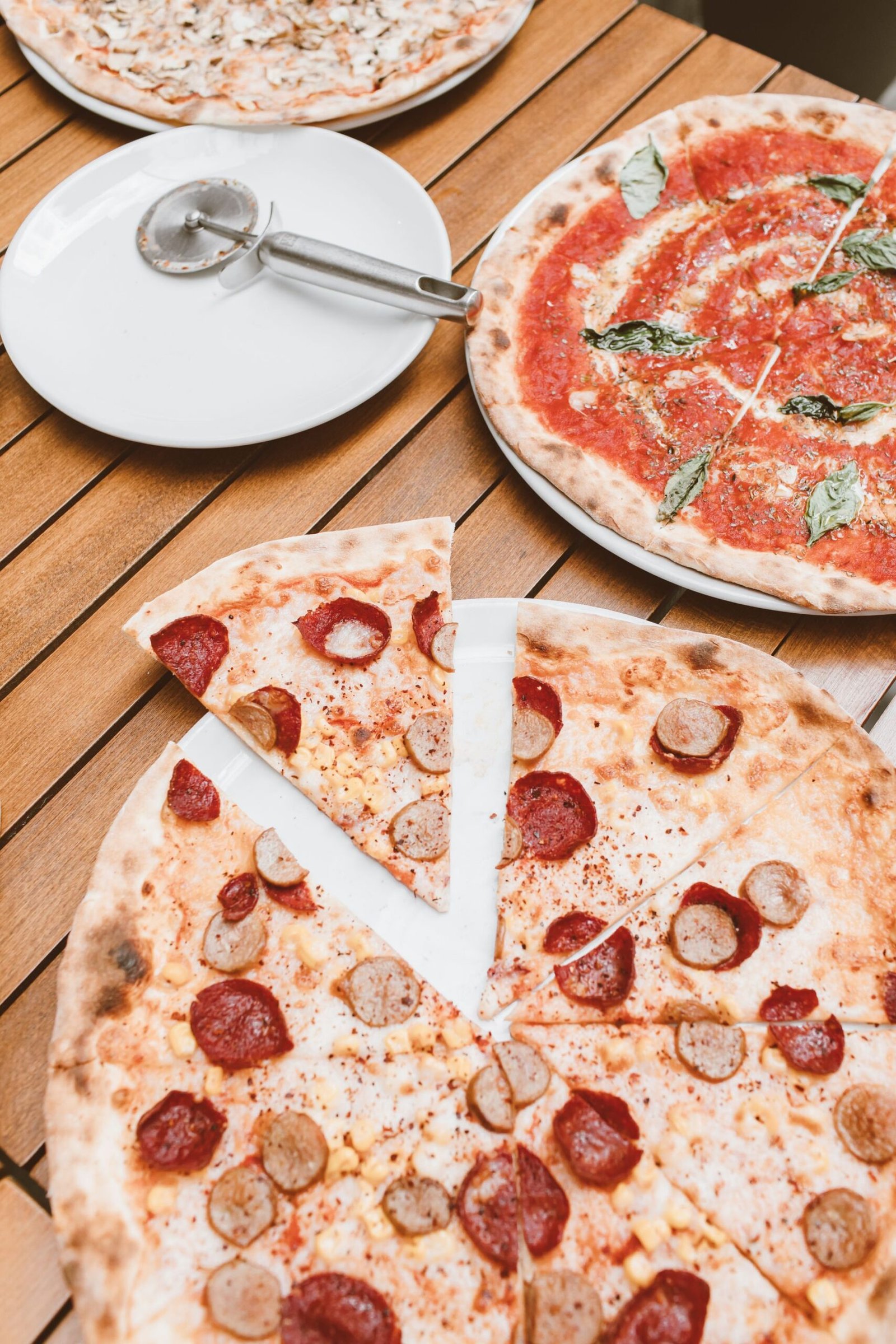
Squares, not wedges. A 12-inch tavern pizza is typically cut into 12–16 small squares, with the corner pieces prized for their extra-crisp edges. The small size is functional: the thin crust can’t support a giant floppy triangle the way a New York slice can. Squares stay rigid, making them genuinely finger food. Cut with a sharp pizza wheel or a large chef’s knife in a decisive motion — sawing drags the toppings.
Sturdy, salty, and beer-friendly
The flavor profile leans savory and salty: fennel-heavy Italian sausage is the iconic topping, often with a sprinkle of oregano and sometimes a dusting of Parmesan. The crust itself is typically lean — flour, water, yeast, salt, a little oil — with no sugar, which keeps it crisp rather than soft. It’s pizza as bar snack elevated to an art form.
The Dough: Low Hydration Is the Secret
Tavern-style dough is notably drier than most pizza doughs — around 50–55% hydration versus the 60–65% typical of Neapolitan or New York styles. That low hydration is the whole game: less water means a crisper, more cracker-like result and a dough firm enough to roll paper-thin without tearing.
Tavern-style dough (for two 12-inch pizzas)
- 400 g (about 3¼ cups) all-purpose flour
- 200 ml (¾ cup + 1 tablespoon) cool water
- 2 teaspoons instant dry yeast
- 1½ teaspoons fine sea salt
- 2 tablespoons olive oil or neutral oil
- 1 teaspoon sugar (optional; aids browning slightly)
All-purpose flour is traditional here — bread flour’s extra protein makes the thin crust tough rather than crisp. Mix and knead 8–10 minutes until smooth and firm; this dough will feel stiffer than you’re used to, and that’s correct. Let it rise 1–1½ hours until puffy (it won’t double dramatically — low-hydration doughs rise modestly), then divide in two. For a deeper understanding of how water ratios transform crust, our pizza dough hydration guide is essential reading.
Rolling thin: technique matters
This is the skill that makes or breaks tavern-style. On a well-floured surface, roll the dough with a rolling pin — not your hands — to a 12–13 inch round, ⅛ inch thick or slightly less. Roll from the center outward, rotating frequently for an even circle. The dough will resist; let it rest 5 minutes and roll again rather than forcing it. Dock the entire surface thoroughly with a fork or a docker — this is non-negotiable. Undocked thin dough balloons into giant bubbles in a hot oven, and on a crust this thin, a bubble means a burnt blister.
Transfer the docked round to a floured peel. Because the dough is low-hydration and firm, it handles like a dream on the peel — one of the style’s quiet advantages. If you’re nervous about the launch, build the pizza on parchment and slide parchment and all onto the hot surface.
Sauce, Cheese, and Classic Toppings
The sauce: thin and tangy
Tavern sauce is typically a simple uncooked tomato sauce — crushed tomatoes, oregano, garlic, salt — applied in a thin layer. Thin matters doubly here: the crust is delicate, and a thick sauce layer will sog it before it crisps. Some Chicago taverns use a slightly sweeter sauce than the New York style; a pinch of sugar in the sauce (not the dough) nods to that tradition without turning it into candy. As with all uncooked sauces, use good canned tomatoes — look for DOP certification and a short ingredient list on the label.
The cheese: full coverage, low moisture
Unlike grandma pizza’s patchwork, tavern-style gets an even blanket of low-moisture mozzarella edge to edge — typically 6–8 ounces for a 12-inch pie. The even layer insulates the thin crust from the sauce above, which is structural, not just aesthetic. A sprinkle of grated Parmesan or Romano over the mozzarella before baking adds the salty punch the style is known for. Fresh mozzarella has no place here; its water would destroy a crust this thin in minutes. See our mozzarella comparison for the full reasoning.
The iconic toppings
Italian sausage with fennel is the quintessential tavern topping — pinched into small pieces and distributed evenly so every square gets some. Pepperoni is the other classic; on a thin crust, it crisps into little cups that hold their rendered fat. Mushrooms, onions, and green peppers all appear, but the cardinal rule is lightness: this crust cannot carry a loaded pie. Pre-cook mushrooms and peppers to drive off their water — on a cracker crust, there’s nowhere for vegetable moisture to hide. For topping inspiration beyond the classics, a good topping-combinations roundup has ideas that adapt well to the thin format.
Food safety on a fast bake
Tavern pizzas bake fast — often under 10 minutes — which leaves no margin for raw meats to cook through. Use pre-cooked sausage or add raw sausage in very small pieces, and verify any meat reaches 165°F (74°C) internally with a food thermometer. When in doubt, pre-cook. The thin crust and short bake that make this style great also make it unforgiving of food-safety guesswork.
Baking: Hot, Fast, and Watchful
Preheat your oven to its maximum — 500–550°F — with a pizza steel or stone inside for a full 45–60 minutes. For tavern-style, steel has a real edge over stone: its superior heat transfer crisps the thin bottom faster, which matters when the whole bake takes 7–10 minutes. Our steel vs stone comparison breaks down the physics if you’re choosing.
Launch the topped pizza onto the hot surface and bake 7–10 minutes. That’s not a typo — a crust this thin cooks dramatically faster than a standard pizza. You’re looking for a deeply golden bottom (peek with a peel), cheese that’s fully melted with browned spots, and edges that are crisp and browned but not black. The window between perfect and burnt is narrow: start checking at 6 minutes, and don’t walk away. If the top is browning faster than the bottom crisps, your steel wasn’t preheated long enough — note it for next time rather than trying to fix it mid-bake.
Because the bake is so fast, an infrared thermometer is genuinely useful here — knowing your steel is actually at 500°F+ before launching removes the biggest variable. And bake on the middle or lower-middle rack; too close to the broiler element and the cheese scorches before the bottom sets.
Pro Tips for Tavern-Style Success
Roll it thinner than you think
Almost everyone under-rolls their first tavern crust. If you think it’s thin enough, roll it a little thinner. You’re aiming for something approaching a flour tortilla — you should be able to see the counter’s color faintly through the dough. A thick tavern-style pizza isn’t tavern-style; it’s just a thin-crust pizza, and the shattering texture only happens at true cracker thinness.
Dock aggressively
Poke holes across the entire surface, every inch or so, with a fork or docker. Then dock it again. On a normal pizza, a bubble is a minor flaw; on a ⅛-inch crust in a 550°F oven, an undocked bubble becomes a burnt blister in 90 seconds. This single step separates successful tavern pizzas from frustrating ones.
Keep the topping layer thin and dry
Every topping should earn its place. Sauce in a thin layer, cheese in an even but not mountainous blanket, and a restrained hand with everything else. Pat fresh vegetables dry, pre-cook mushrooms, drain canned artichokes well. A cracker crust has no crumb structure to absorb excess moisture — what you put on top is what you get, for better or worse.
Cut decisively, serve immediately
Use a sharp wheel or a large chef’s knife and cut in firm, decisive strokes — sawing drags cheese and toppings. Cut the 12-inch pie into a 4×4 grid for 16 party squares. And serve right away: tavern-style is at its absolute peak in the first 10 minutes, when the contrast between the shattering crust and molten cheese is at its maximum. It holds okay for 20–30 minutes, but it never improves with waiting. This is not a make-ahead style.
Season the crust edge
With no puffy rim to carry flavor, the flat edge needs help. A light brush of garlic butter or olive oil on the outer inch right after baking — plus a pinch of flaky salt or Parmesan — gives the edge pieces the savory punch that makes them the most fought-over squares on the board.
Tavern-Style Variations
Sausage and giardiniera
The Chicago purist’s order: fennel sausage plus giardiniera — the tangy, oily pickled vegetable relish that’s practically a civic emblem. Add the giardiniera after baking so its vinegar punch stays bright against the rich sausage. Chop it fine so it distributes across the small squares.
Pepperoni and hot honey
Pepperoni cups plus a drizzle of hot honey after baking. The sweet-heat against the salty crisp crust is addictive, and the honey’s viscosity works beautifully on the flat surface — it stays where you put it instead of sliding off a domed rim.
Veggie tavern
Thin-sliced mushrooms (pre-sautéed), roasted red peppers (patted very dry), red onion slivers, and black olives over the standard cheese blanket. The key is the pre-cooking — raw vegetables weep, and on this crust, weeping is fatal. Finish with fresh basil after baking for color and aroma.
St. Louis cousin
Curious about the other great Midwestern thin pizza? St. Louis style takes thinness even further — an unleavened cracker crust with Provel cheese, also cut in squares; try both and pick your Midwestern allegiance.
Serving and Storing
Tavern-style is party pizza by design: one 12-inch pie cut into 16 squares serves 3–4 as a snack or 2 as a meal, and the format scales beautifully — make three or four pies for a gathering and watch them vanish. Serve on a wooden board with the squares slightly separated so steam escapes (stacking traps steam and softens the crisp). Cold beer is the traditional accompaniment, obviously; a crisp lager or pilsner is the classic pairing.
Storage is straightforward but the reheating matters more than usual, because the whole point is the shatter. Refrigerate leftovers within 2 hours in an airtight container for up to 3–4 days. Reheat in a 400°F oven directly on the rack for 5–7 minutes — the dry heat re-crisps the thin crust better than any other method. The microwave is particularly cruel to tavern-style; it turns cracker into leather. Refrigerate within 2 hours and use within 3–4 days.
Frequently Asked Questions
Is tavern style pizza the same as thin-crust pizza?
Thin-crust is a broad category; tavern-style is a specific regional tradition within it. What makes tavern-style distinct is the combination: cracker-thin unleavened-leaning crust, toppings edge to edge with no rim, the square party cut, and the barroom serving culture. A generic “thin crust” pizza might have a puffy edge and wedge slices — a tavern pie never does. Our thin crust vs thick crust guide covers the broader category if you want the full landscape.
What’s the difference between tavern-style and Chicago deep dish?
They’re opposites that happen to share a city. Deep dish is thick, baked in a deep pan, eaten with a knife and fork, with sauce on top of the cheese — a hearty restaurant meal. Tavern-style is cracker-thin, cut in squares, eaten by hand, with cheese over sauce — casual bar food. Deep dish is what tourists order; tavern-style is what Chicagoans eat weekly. Our Chicago deep dish guide covers the thick side of the city’s pizza identity.
Why is tavern-style pizza cut into squares?
Practicality from its barroom origins: small squares are easy to share among a crowd, easy to eat with one hand while holding a drink, and they make one pizza feed more people. The thin crust also can’t support large floppy triangles — squares stay rigid. The corner pieces, with two crisp edges, are traditionally the most coveted.
What toppings are most traditional on tavern-style pizza?
Italian sausage with fennel is the canonical order, followed closely by pepperoni. The classic Chicago combination is sausage and mushroom, or pepperoni and green pepper — simple, savory, and salty enough to pair with beer. Fancier toppings appear on modern menus, but the style’s soul is humble: a few well-chosen toppings, applied lightly, over that shattering crust. When in doubt, sausage it.
Can I make tavern-style pizza without a pizza steel or stone?
You can get close. Flip a heavy rimmed baking sheet upside down, preheat it like a steel, and bake the pizza on it — the preheated metal gives you the bottom heat the style needs. A cast-iron pizza pan or a preheated cast-iron skillet (for a round version) also works well. What you can’t do is bake it on a room-temperature sheet pan; without preheated thermal mass, the thin bottom won’t crisp before the top overcooks.
My tavern crust puffed up / burned / went soggy. What happened?
Puffed up means under-docked — dock more aggressively next time. Burned usually means the oven was too hot on top (rack too high) or you walked away during the 7–10 minute bake; this style needs active watching. Soggy means too much topping moisture — thinner sauce, pre-cooked vegetables, less cheese. The style is simple but unforgiving; each variable matters more when the crust is this thin.
Can I cold-ferment tavern-style dough?
Yes, and it improves the flavor noticeably. After kneading, refrigerate the dough balls for 24–72 hours, then let them warm up for 1–2 hours before rolling. Cold dough is stiffer and actually rolls thinner more easily — a nice bonus. The low hydration means it won’t over-ferment quickly, so the window is forgiving. Just remember to dock well; cold-fermented dough can be extra lively in a hot oven.