

Neapolitan pizza is the ancestor of every pizza you have ever eaten — and in many ways, still the pinnacle. Born in Naples, Italy, it is defined by a soft, pillowy crust with a puffy, leopard-spotted rim, a thin soupy center, bright uncooked tomato sauce, and fresh mozzarella, all baked in about 90 seconds in a blazing wood-fired oven. It is less a recipe than a living tradition, guarded by an official association with written rules, and it was recognized by UNESCO as an intangible cultural heritage — the art of the Neapolitan pizzaiolo itself deemed worth protecting.
What makes Neapolitan pizza fascinating for home bakers is the gap between the ideal and the achievable. The true Neapolitan bake happens at around 900°F (480°C) — temperatures no home oven reaches — which means a faithful home version requires smart adaptations rather than literal imitation. The good news: you can capture the soul of Neapolitan pizza at home. The soft, airy rim, the simple toppings, the blistered char — all achievable with the right dough formula, a pizza steel, and your oven’s broiler working overtime.
This guide covers everything: the real history from Naples’ streets to UNESCO recognition, the defining characteristics of the style, the official rules that govern what can legally be called a true Neapolitan pizza, a home-adapted recipe with weights and temperatures, and how Neapolitan differs from its famous cousins like New York style. Whether you are chasing authenticity or just a better pizza night, this complete guide is the full picture.
🍕 Key Takeaways
- Neapolitan pizza originated in 18th-century Naples as street food for the working poor; the Margherita was named for Queen Margherita in 1889.
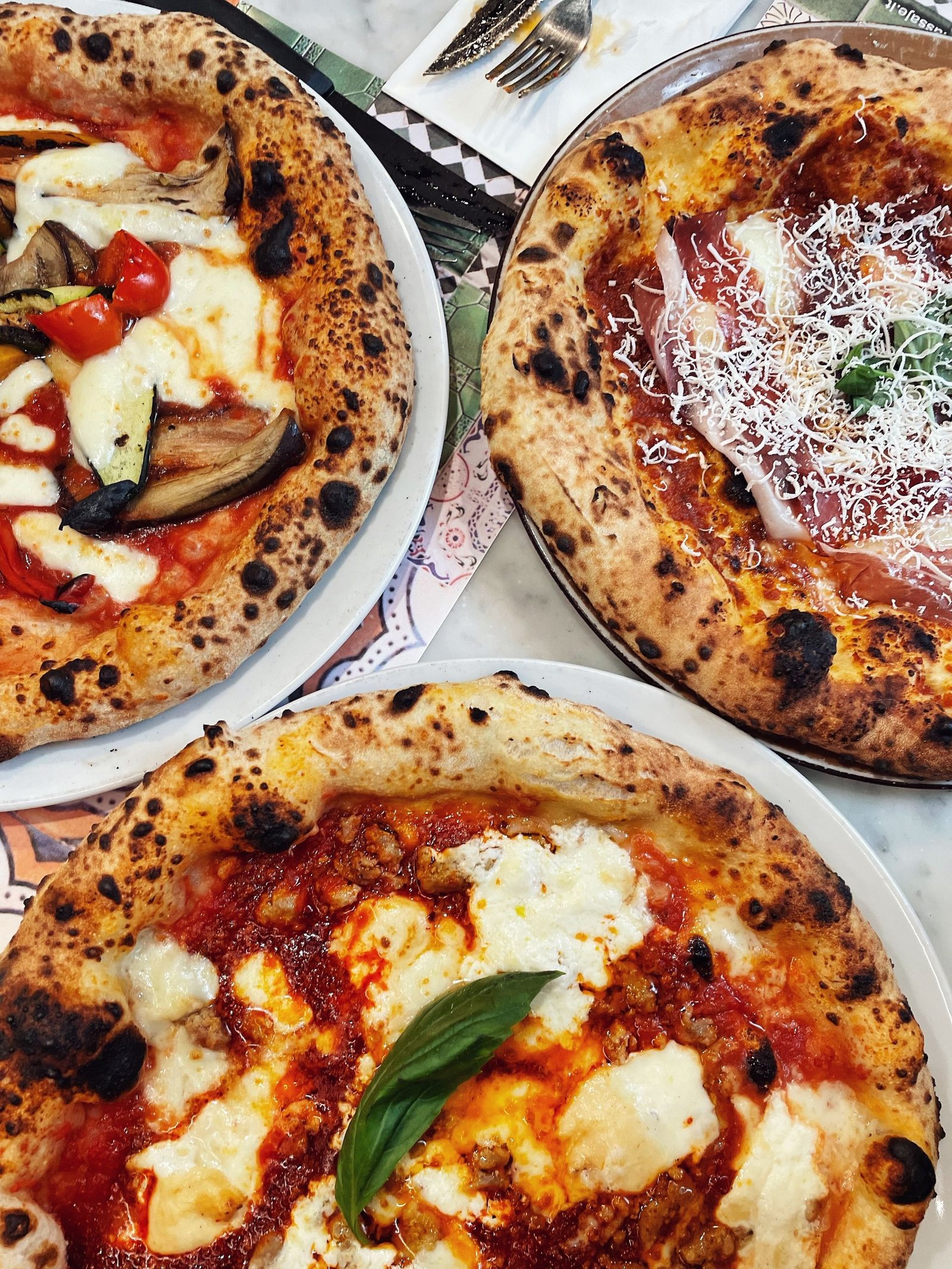
- Defining traits: soft, puffy leopard-spotted rim (cornicione), thin soft center, San Marzano tomato sauce, fior di latte or buffalo mozzarella, baked ~90 seconds at ~900°F (480°C).
- The AVPN (Associazione Verace Pizza Napoletana) certifies true Neapolitan pizza with strict rules on ingredients, dough, and bake.
- Home adaptation: 60–62% hydration 00-flour dough, 24-hour cold ferment, pizza steel + broiler at max oven temp, 4–6 minute bake.
- Neapolitan differs from New York style in bake temperature, crust texture (soft vs. crisp-chewy), and size — Neapolitan is personal-size, eaten with a knife and fork.
- UNESCO recognized the art of Neapolitan pizzaioli as intangible cultural heritage in 2017.
History: From Naples Street Food to World Heritage
Pizza’s story begins in Naples in the 1700s, but it does not begin as the food we know. The flatbreads of Naples were the food of the lazzaroni — the city’s working poor — sold by street vendors from carts and eaten on the go. Tomatoes, a New World import initially feared as poisonous by northern Europeans, were embraced by Neapolitans, and the combination of flatbread, tomato, and cheap local cheese created something new. By the early 1800s, dedicated pizzerias had appeared in Naples, and visitors wrote home about this strange, delicious street food. Our broader history of pizza traces this evolution in full; the Neapolitan chapter is its heart.
The founding legend — and like all good legends, part true — dates to 1889, when pizzaiolo Raffaele Esposito of Pizzeria Brandi allegedly created a pizza in the colors of the Italian flag for Queen Margherita of Savoy’s visit to Naples: red tomato, white mozzarella, green basil. He named it the Margherita in her honor. Historians note that tomato-mozzarella-basil pizzas existed before 1889, but Esposito’s royal association gave the dish a name and a story that carried it around the world. The Margherita remains the canonical Neapolitan pizza, alongside its sibling the Marinara (tomato, garlic, oregano, olive oil — no cheese, named for the fishermen, la marinara, who ate it).
Neapolitan pizza traveled with Italian immigrants, most famously to America, where it evolved into new styles under new conditions — cooler ovens, different flours, bigger appetites. But in Naples, the tradition held its line. In 1984, a group of pizzaioli founded the Associazione Verace Pizza Napoletana (AVPN) — the True Neapolitan Pizza Association — to define and defend the authentic product against imitation, writing down standards that had previously lived only in hands and memory. And in 2017, UNESCO inscribed “the art of Neapolitan pizzaioli” on its list of Intangible Cultural Heritage of Humanity — recognizing not a recipe but a living craft: the twirling, the slapping, the knowledge passed hand to hand across generations.
Defining Characteristics: What Makes It Neapolitan
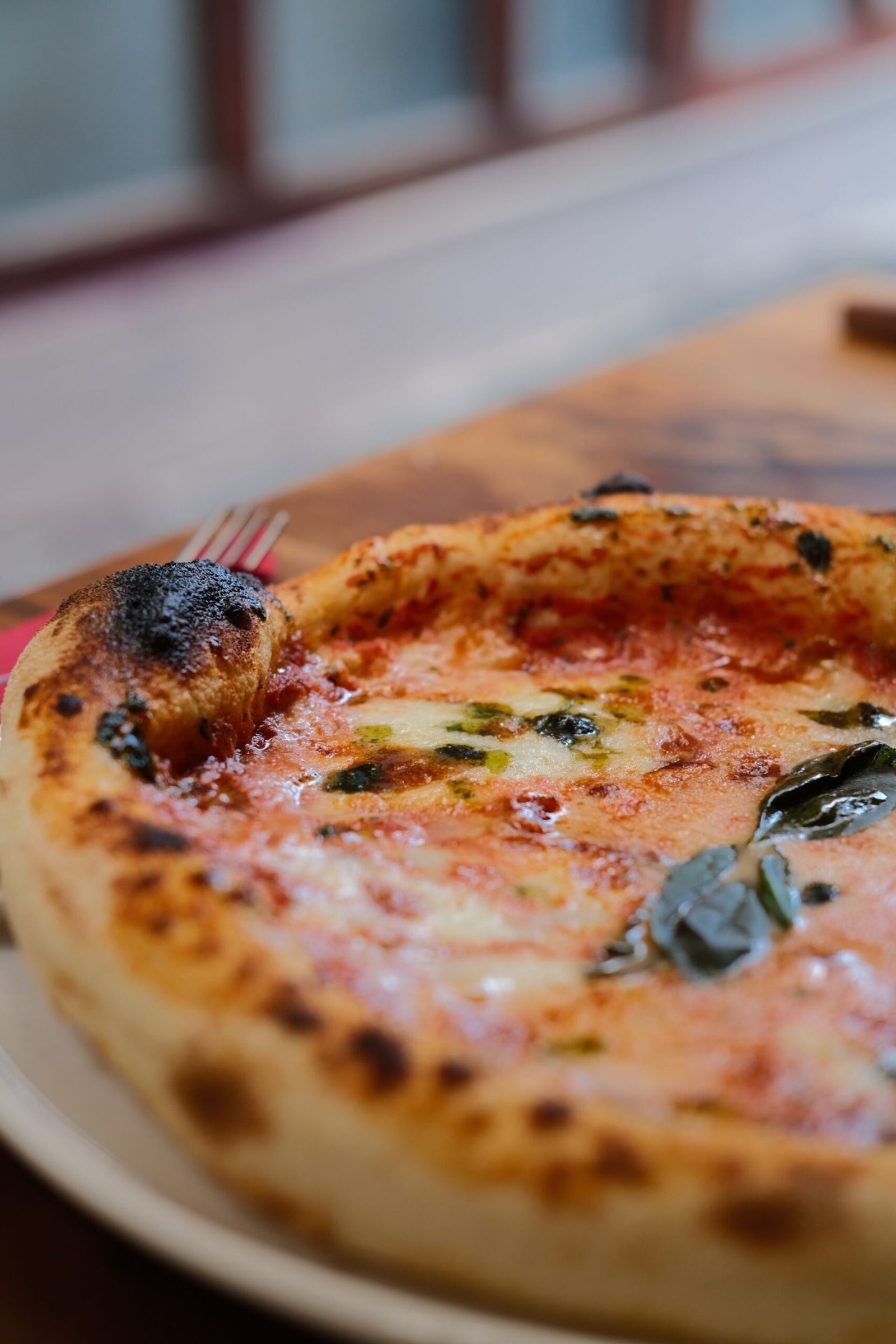
A true Neapolitan pizza is recognizable at a glance and unmistakable in the bite. The crust is the star: a tall, puffy outer rim called the cornicione, airy and soft with characteristic charred blisters — “leopard spotting” — from the intense heat. The center is thin, soft, and slightly soupy, folding under its toppings rather than supporting them rigidly. This softness is not a flaw; it is the style. Neapolitan pizza is eaten with a knife and fork, often folded into a wallet shape (a portafoglio) for street eating. Anyone expecting a rigid, crispy crust is expecting a different pizza.
The dough is lean and simple: 00 flour, water, salt, and yeast — no oil, no sugar, nothing else. Hydration runs around 60–65%, and the dough ferments at room temperature for many hours or overnight, developing flavor and an open, airy structure. Dough balls are portioned for individual pizzas, roughly 10–12 inches in diameter — Neapolitan pizza is personal-size by tradition, one per person, never sliced for sharing the way American pizzas are.
Toppings follow strict simplicity. The sauce is crushed San Marzano tomatoes — grown in the volcanic soil near Naples, prized for sweetness and low acidity — applied uncooked with just salt. Many pizzaioli crush them by hand tableside or in the kitchen, never blending, because a blender’s blades aerate the tomatoes and dull their bright flavor. Cheese is fior di latte (fresh cow’s milk mozzarella) or mozzarella di bufala (buffalo mozzarella), applied sparingly because it releases water in the fierce heat. The classic Margherita adds only fresh basil, a drizzle of olive oil, and salt. The Marinara skips cheese entirely for tomato, sliced garlic, oregano, and olive oil. Extravagant topping combinations are un-Neapolitan; restraint is the aesthetic.
The bake is the most extreme in all of pizza: 60–90 seconds in a wood-fired oven running around 850–950°F (450–510°C). This violent heat does in a minute what home ovens do in ten — it flash-sets the exterior while leaving the interior soft and moist, puffs the rim dramatically (oven spring on overdrive), and chars spots across the crust without burning it through. The result cannot be fully replicated at lower temperatures, which is why the home adaptation below focuses on capturing the spirit — the soft puffy rim, the simple toppings, the char — rather than pretending a home oven is a wood fire.
The AVPN Rules: What “True” Neapolitan Means
The AVPN’s regulations read like a legal code for pizza, and they are worth knowing even if you never seek certification — they distill generations of craft into specific standards. The flour must be 00 type (very finely milled soft wheat), and the ingredient list is closed: flour, water, sea salt, and yeast (fresh brewer’s yeast traditionally, though the rules accommodate modern equivalents). No oil, no sugar, no dough conditioners. Water must be natural and potable. These constraints are not snobbery; each exclusion protects the style’s character — oil would crisp what should be soft, sugar would brown what should blister.
The dough method is specified: mix, knead, ferment in bulk, then form into individual balls (panetti) and proof them before stretching. Stretching must be done by hand — the rules explicitly forbid rolling pins and mechanical presses, because hand stretching preserves the rim’s air while machines crush it. The formed pizza must be round, with a raised rim, and within a personal-size diameter range. Toppings for the two canonical pizzas are fixed: the Margherita (tomato, fior di latte or buffalo mozzarella, basil, olive oil) and the Marinara (tomato, garlic, oregano, olive oil).
The bake must be in a wood-fired oven at the traditional extreme temperatures, for roughly a minute to ninety seconds. The AVPN even certifies pizzerias worldwide that meet these standards — the little wood-fired-oven logo in a pizzeria window means it passed inspection. For home bakers, the rules serve as a north star rather than a cage: follow the ingredient discipline and the hand-stretching, adapt the bake to your equipment, and you are making Neapolitan-style pizza in the truest sense that a home oven allows. Purists may object; your dinner guests will not.
Neapolitan Pizza at Home: The Adapted Recipe
This recipe captures Neapolitan character in a home oven: 00 flour, high hydration, long ferment, and a steel-plus-broiler bake that approximates wood-fired intensity. Makes four 10–11 inch pizzas.
Dough (24-hour version): 500 g “00” flour (about 4 cups; Caputo-style pizzeria flour if available, otherwise bread flour); 310 g water (62%, about 1⅓ cups) at 65–70°F (18–21°C) — cool water for a slow ferment; 10 g fine sea salt (2 tsp); 3 g instant yeast (1 tsp) — less yeast than same-day doughs, because time does the work; no oil, no sugar.
Method. Mix flour and water until shaggy, rest 20 minutes (autolyse). Add salt and yeast, knead 8–10 minutes until smooth and elastic — the dough will be soft and slightly sticky at 62% hydration with 00 flour, which absorbs water differently than bread flour. Bulk ferment at room temperature (68–72°F / 20–22°C) for 2 hours with one fold, then refrigerate 18–24 hours. (Same-day alternative: use 7 g yeast and ferment 6–8 hours at room temperature, but the cold version tastes better.) Divide into 4 balls of about 205 g each, proof at room temperature 2 hours before baking — the balls should look puffy and relaxed.
Sauce and toppings. Crush a can of San Marzano-style tomatoes by hand, stir in a pinch of salt and a drizzle of olive oil — nothing else, no cooking. For cheese, use fior di latte or low-moisture mozzarella torn small and patted dry (true fresh mozzarella releases too much water at home-oven bake times); about 3–4 ounces (85–115 g) per pizza. Fresh basil leaves and good olive oil go on after baking.
The home bake. Place a pizza steel on the top rack, 4–6 inches from the broiler. Preheat the oven at maximum (500–550°F / 260–290°C) for a full 60 minutes — this long preheat saturates the steel with heat, which is what drives the dramatic oven spring in the rim. Switch to high broil 10 minutes before launching — you want the steel screaming hot and radiant heat blasting from above. Stretch the dough to 10–11 inches, keeping a puffy rim; top lightly (¼ cup sauce, modest cheese). Launch onto the steel and bake 4–6 minutes, rotating once, until the rim is puffed and leopard-spotted and the bottom is charred in patches. Watch closely in the final two minutes — the broiler works fast and the line between spotted and scorched is thin. The broiler mimics the wood oven’s top heat; the steel mimics the deck. It is not 90 seconds at 900°F, but the soft, airy, blistered result is recognizably Neapolitan in spirit. See our oven temperature guide for the full breakdown of heat strategies.
Common home mistakes
Baking too cool or too briefly preheated. The number-one home failure is impatience with the preheat. A steel that has been heating for 20 minutes is nowhere near saturated; the pizza lands, the steel’s surface temperature crashes, and the rim never puffs. The full 60 minutes is not optional — it is the recipe.
Overloading toppings. Neapolitan topping discipline is part of the style, not just tradition. A heavy hand with sauce or cheese at home-oven bake times (4–6 minutes versus 90 seconds) means a waterlogged center that never sets. When in doubt, use less. You can always add a second pizza.
Using bread flour without adjusting. Bread flour works, but its higher protein absorbs water differently and produces a chewier, tougher rim than 00 flour. If substituting, drop hydration to 60% and expect a slightly less delicate result — still delicious, just less authentically tender.
Skipping the long ferment. A 2-hour dough bakes into flat-tasting pizza no matter how hot the oven. The 18–24 hour cold ferment is where Neapolitan flavor comes from — the subtle tang, the wheaty depth, the extensibility that lets you stretch thin without tearing. Time is an ingredient; measure it like one.
Neapolitan vs. Similar Styles
Neapolitan vs. New York. The most useful comparison, because the two are often confused. New York style (full guide) evolved from Neapolitan roots in American coal and gas ovens: it uses bread flour (higher protein) instead of 00, includes oil and sugar in the dough, bakes at 550–600°F for 6–8 minutes instead of 900°F for 90 seconds, and produces a larger (18-inch), thinner, crisp-chewy slice designed to fold — versus Neapolitan’s soft, knife-and-fork personal pie. NY crust is sturdy and foldable; Neapolitan is tender and soupy-centered. Same ancestry, different ovens, different destinies.
Neapolitan vs. Roman (al taglio and tonda). Rome has its own traditions. Pizza al taglio — rectangular, sold by weight, baked in electric ovens at moderate heat — has a crisp, airy crumb closer to focaccia. Pizza tonda Romana is round like Neapolitan but rolled paper-thin and baked crisp — the anti-Neapolitan in texture, all crunch where Naples is all softness. If Neapolitan is pillowy, Roman tonda is crackery.
Neapolitan vs. “Neapolitan-style” wood-fired. Many restaurants advertise Neapolitan-style pizza from gas or wood ovens that do not reach true Neapolitan temperatures, producing a hybrid: puffy rim, but crisper and less soupy than the Naples original. There is nothing wrong with this — it is often delicious — but the AVPN would not certify it. True Neapolitan softness requires the full 900°F blast; anything less drifts toward crispness.
The through-line: Neapolitan is defined by softness, simplicity, and speed — soft crust, simple toppings, 90-second bake. Every similar style changes one of those variables: New York crisps it, Roman thins it, hybrids moderate the heat. Understanding which variable changed tells you exactly what you are eating and why it tastes the way it does.
Serving and Eating Like Naples
Neapolitan pizza has its own etiquette, and it is refreshingly unpretentious. The pizza arrives whole and unsliced — slicing is the eater’s job, done with knife and fork at the table. The classic move is to cut a triangle, fold it, and eat it by hand from there, or to fold the entire pizza into quarters (a portafoglio, “wallet”) for eating on the street. There is no wrong way; Naples is not precious about it.
Pairing is simple: a cold beer (a crisp lager is traditional) or a light red wine. The meal is fast — pizzerias in Naples turn tables in 30 minutes, and a proper Neapolitan pizza is eaten within minutes of leaving the oven, while the rim is still airy and the center still soft. It does not keep well as leftovers; the soft crust firms as it cools, which is why Neapolitans order fresh, eat fast, and order another if still hungry.
If you are serving home-adapted Neapolitan pizza, set expectations kindly: tell guests it is soft-style pizza, best eaten immediately, knife-and-fork welcome. Serve one pizza per person rather than slicing for sharing — the personal-size format is part of the experience, and a whole pizza per guest feels generous in a way sliced sharing never does. And make the classic Margherita first. Before experimenting with toppings, taste the tradition in its simplest form: tomato, mozzarella, basil, and a crust that took 24 hours to become 90 seconds of perfection.
Frequently Asked Questions
Can I make real Neapolitan pizza in a home oven?
You can make excellent Neapolitan-style pizza, but not AVPN-certified Neapolitan — the 900°F wood-fired bake is physically impossible in a home oven. The home adaptation (00 flour, 62% hydration, long ferment, steel + broiler at max temp) captures the soft puffy rim, leopard spotting, and simple toppings faithfully. For most eaters, the difference is academic.
What is “00” flour and do I need it?
“00” (doppio zero) is Italy’s finest flour grind, milled from soft wheat. It produces Neapolitan dough’s characteristic tenderness and extensibility. It is worth buying for this style — bread flour works but gives a chewier, less delicate result. Look for flour labeled “00 pizzeria” from Italian mills.
Why is the center of Neapolitan pizza soupy?
Because it is supposed to be. The thin center, wet fresh mozzarella, and 90-second bake mean the middle stays soft and slightly liquid — Neapolitans consider this correct, even desirable. If soupiness bothers you, use less sauce, pat the mozzarella very dry, or accept that you prefer New York style — no shame in it.
What is leopard spotting?
The charred blisters on the puffy rim (cornicione), caused by intense heat hitting air bubbles in the dough. It is the visual signature of a proper Neapolitan bake — blackened spots on golden crust. A rim without spotting was baked too cool; a rim that is black all over was baked too long.
How is the Marinara different from the Margherita?
The Marinara is the older, simpler pizza: tomato, sliced garlic, oregano, and olive oil — no cheese. It was the fishermen’s pizza, made with pantry ingredients that kept without refrigeration. The Margherita adds mozzarella and basil. Both are AVPN-canonical; the Marinara is also the traditional choice for vegans.
Do I need a wood-fired oven to make good Neapolitan-style pizza?
No — but heat is non-negotiable. A pizza steel plus your oven’s broiler at maximum temperature gets you remarkably close. Countertop pizza ovens that reach 750–900°F are the next step up and genuinely transform home Neapolitan baking. But the dough formula and technique matter more than the oven; great dough in a home oven beats mediocre dough in a wood oven.