

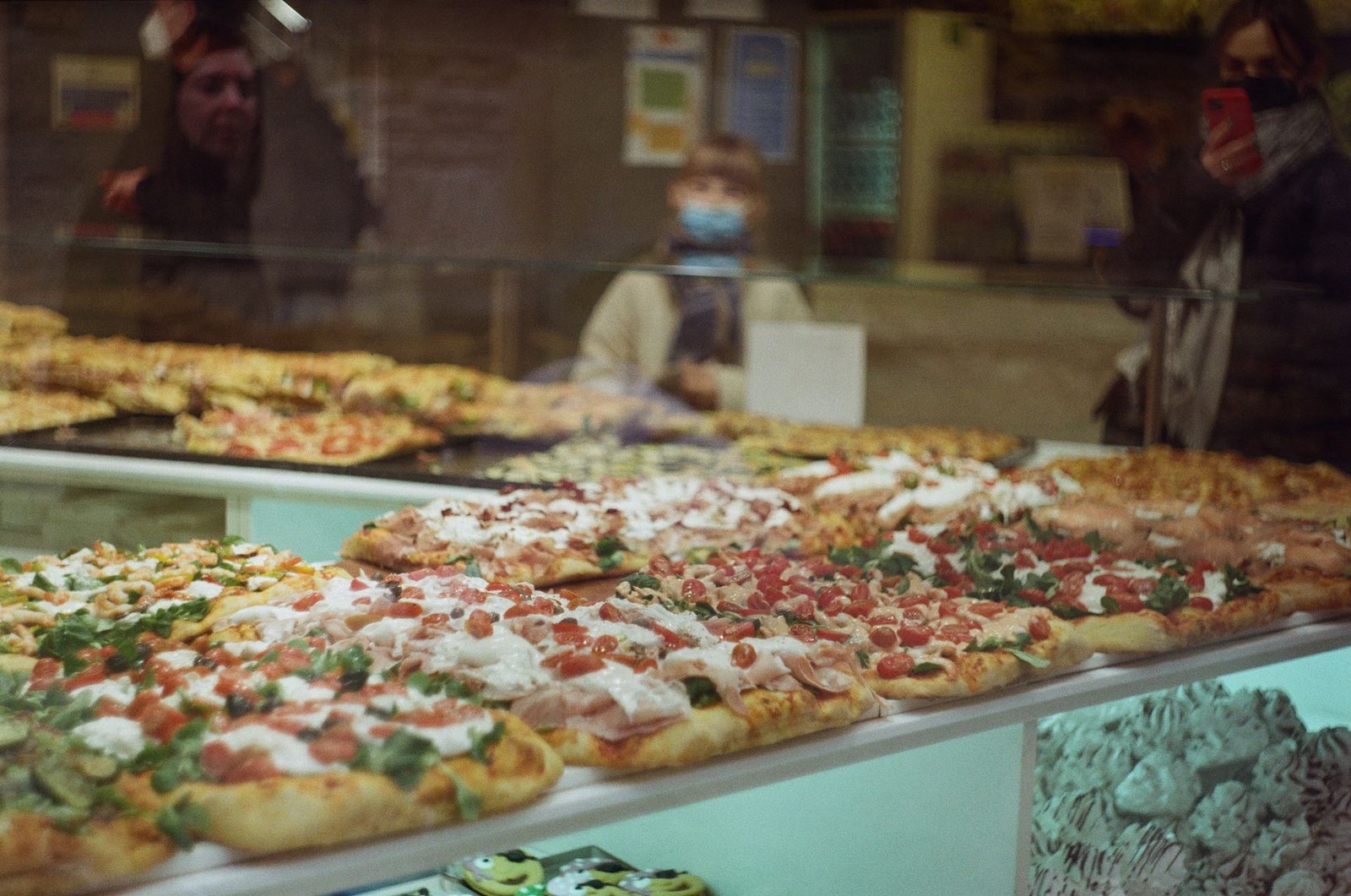
In Rome, pizza isn’t round. It’s rectangular, sold from towering glass cases in bakeries and tiny storefronts called pizzerie al taglio, cut to whatever size you point at, weighed, priced by the etto (100 grams), reheated until the bottom crackles, and handed to you on a sheet of paper. Pizza al taglio — literally “pizza by the cut” — is Rome’s everyday pizza: the lunch-break slice, the after-school snack, the thing you eat standing up while walking to the next thing.
What makes pizza al taglio special isn’t just the shape. It’s a style built on extreme hydration doughs (sometimes 80% water or more), very long cold fermentations, and a baking method that produces a crust that’s simultaneously light, airy, crisp on the bottom, and chewy in the middle. Toppings range from the classic (potato and mozzarella, tomato and basil) to the wildly creative (mortadella with pistachio, figs with prosciutto, zucchini flowers) — and many are added after baking, so they stay fresh and vibrant. The result is a style that eats lighter than it looks and invites endless experimentation. This guide covers the Roman origins, the defining techniques, a home recipe, and how al taglio differs from every other square pizza.
🍕 Key Takeaways
- Pizza al taglio (“pizza by the cut”) is Rome’s rectangular street pizza, sold by weight and reheated to order in bakeries across the city.
- The dough is extremely wet — 70–80% hydration — with a 24–72 hour cold fermentation for a light, airy, digestible crumb.
- Bake in a well-oiled sheet pan at 450–500°F (232–260°C); the high heat and oil produce a crisp, golden bottom with a chewy, open interior.
- Toppings are often added after baking (mortadella, fresh mozzarella, arugula) so they stay fresh — a signature of the style.
- Gabriele Bonci of Pizzarium pioneered the gourmet al taglio movement with heritage grains, long fermentations, and inventive toppings.
- At home, par-bake the base, top it, and finish with a hot reheat — the same two-stage method Roman shops use.
- Al taglio differs from Sicilian in its lighter, crisper texture and by-weight selling; from focaccia in its pizza-style topping and bake.
The History of Pizza al Taglio
Pizza al taglio as Romans know it is younger than you’d expect — a mid-20th-century creation rather than an ancient tradition. After World War II, as Rome rebuilt and modernized, bakers began selling pizza from their bakery ovens as a convenient, affordable food for workers. The rectangular shape was pure practicality: sheet pans fit bakery ovens efficiently, and rectangular slabs could be cut to any size and sold by weight, so a customer could buy exactly as much as they wanted for exactly as much as they wanted to spend.
The style evolved quietly for decades as Rome’s working lunch. Then, in the early 2000s, a baker named Gabriele Bonci transformed it. At his tiny shop Pizzarium, near the Vatican, Bonci applied artisan-bread thinking to street pizza: stone-milled heritage grains, very high hydration, 48-plus-hour fermentations, and toppings that read like a tasting menu — stewed octopus, broccoli rabe with sausage, carbonara-inspired combinations. Pizzarium became a pilgrimage site, Bonci became known as the Michelangelo of pizza, and pizza al taglio went from humble lunch to gourmet destination. A generation of Roman bakers followed his lead, and today the best pizzerie al taglio in Rome rival any pizzeria in the world.
The ordering ritual is part of the experience and worth knowing if you visit Rome. You point at the slabs in the case and indicate with your fingers how big a piece you want — a small square, a long strip. The pizzaiolo cuts it with scissors (scissors! — the correct tool for this crust), weighs it, reheats it in a hot oven for a few minutes until the bottom re-crisps, and hands it over on paper. You pay by weight. It’s fast, it’s cheap by Rome standards, and the quality at a good shop is extraordinary — many Romans will tell you their neighborhood taglio shop beats most sit-down pizzerias. Beyond Pizzarium, shops like Antico Forno Roscioli, La Renella, and Trapizzino (which stuffs its triangular bianca pockets with Roman fillings) show the range of the tradition. For more on how pizza customs differ around the world, see our pizza etiquette guide.
The Defining Characteristics of Pizza al Taglio
Extreme hydration dough
Al taglio dough is among the wettest in all of pizza — typically 70–80% hydration, sometimes higher. At those levels the dough is more batter than dough: slack, sticky, barely kneadable by hand. Roman bakers mix it, fold it a few times over several hours, and let time do the work. The payoff is a crumb full of large, irregular holes — light as air in places, chewy in others — with a crisp shell.
High hydration also means high extensibility: the dough spreads to fill the pan almost by itself, which is why Roman bakers can portion it so quickly during a lunch rush. If you’re new to working with wet doughs, our pizza dough hydration guide explains baker’s percentages and handling techniques, and how to stretch pizza dough covers the gentle handling these doughs demand.
Long, cold fermentation
The classic al taglio dough ferments cold for 24 to 72 hours. This isn’t just about flavor — though the flavor is remarkable, complex and faintly tangy — it’s about structure. The long, slow fermentation develops the gluten network gently and produces organic acids that strengthen the dough, so it can hold its extreme hydration without collapsing. It also makes the pizza famously digestible; Romans will tell you al taglio never sits heavy, and the long fermentation is why.
Our cold ferment pizza dough guide covers the technique in depth. For al taglio, push the ferment to the long end — 48 hours is the sweet spot for home bakers.
The two-stage bake
Roman shops bake in two stages, and you should too. First, the topped (or sometimes untopped) base bakes in a well-oiled sheet pan at high heat — 450–500°F (232–260°C) — until the bottom is crisp and golden and the crumb is set. Then it’s cooled, portioned, and held. When you order, your piece gets its final toppings (if they’re fresh ones) and a blast in a hot oven that re-crisps the bottom and melts everything together.
This two-stage method is why reheated al taglio tastes freshly baked — it essentially is, the second time. At home, it means you can bake the base ahead, then finish pieces to order throughout a party. Nobody gets a lukewarm slice.
Toppings: classic and creative, often added after
Al taglio toppings fall into two camps. The classics are baked on: potato and mozzarella (patate e mozzarella — thin-sliced potato, rosemary, mozzarella), simple tomato and basil, zucchini, mushrooms. The gourmet camp adds toppings after baking: paper-thin mortadella draped over a hot base, fresh mozzarella and basil, arugula and cherry tomatoes, figs and prosciutto in season. Post-bake topping keeps delicate ingredients fresh and vibrant instead of oven-wilted, and it’s one of the style’s signature moves.
The creativity is the point. Where a Neapolitan menu might list eight pizzas, a good taglio shop shows twenty slabs, changing with the seasons. For inspiration across styles, our best pizza topping combinations rounds up 25 ideas from classic to creative.
Crisp bottom, airy middle
The textural ideal is specific: a bottom crust that’s crisp and golden from the oiled pan, giving way to an interior that’s light, open, and chewy — never dense, never doughy. The top should have some charred bubbles. Achieving this at home means a fully preheated oven, generous oil in the pan, and not overloading with wet toppings. A pizza steel under the sheet pan helps enormously with bottom crispness in home ovens.
Choosing Flour for Pizza al Taglio
Flour choice shapes the final texture more in al taglio than in almost any other style, because the extreme hydration exposes every weakness.
Bread flour is the reliable home choice. Its high protein (12–14%) builds the strong gluten network needed to trap gas in a 75%-hydration dough. The result is chewy, structured, and forgiving.
00 flour (or a 50/50 blend with bread flour) gives a more authentically Roman result — slightly more tender, a little less chewy, with a finer crumb. But 00 absorbs less water, so drop hydration to about 70% when using it straight, or the dough becomes unmanageable.
Heritage and whole grains are the Bonci signature: stone-milled farro, spelt, or whole wheat blended at 20–30% with bread flour. They add nutty flavor and beautiful color but drink more water and ferment faster — bump hydration up a touch and watch the dough closely. Our pizza flour guide compares 00, bread flour, and all-purpose in detail.
Whatever you choose, skip all-purpose flour for your first attempts — its lower protein struggles at 75% hydration, and you’ll get a slack, tearing dough that bakes up dense.
Pizza al Taglio for Parties: The Ultimate Crowd Strategy
Here’s why al taglio is the best pizza style for entertaining: the two-stage bake means you can bake all your bases in the morning, set up a topping bar, and finish pieces to order in 3–5 minutes all evening. No one waits 20 minutes for a fresh pie; everyone gets a hot, crisp-bottomed piece with exactly the toppings they want.
Plan one half-sheet pan per 6–8 guests as a main event (fewer if it’s a snack spread). Bake two or three bases with different baked-on foundations — one potato-mozzarella, one simple tomato, one plain for post-bake creativity. Keep fresh toppings in bowls: mortadella, prosciutto, fresh mozzarella, arugula, roasted vegetables, chili honey. Guests point, you cut with scissors, finish in a 500°F oven, and serve on paper. It’s interactive, it’s Roman, and it scales effortlessly. Our pizza party hosting guide covers quantities, timing, and setup for bigger crowds, and the family pizza night ideas roundup has more ways to make it an event.
Pizza al Taglio Recipe for Home Ovens
This makes one half-sheet pan (13×18 inches) — about 8–10 pieces. Start 2 days ahead for the full 48-hour ferment.
The dough
- 4 cups (480g) bread flour (or half bread flour, half 00 flour for a more Roman texture)
- 1 3/4 cups plus 2 tablespoons (445ml) cool water (about 75% hydration — see note below)
- 2 teaspoons instant yeast (use less for longer ferments: 1 teaspoon for 72 hours)
- 2 teaspoons fine sea salt
- 2 tablespoons extra-virgin olive oil, plus 1/4 cup for the pan
Note on hydration: 75% is the home-baker sweet spot — wet enough for an open crumb, manageable enough to handle. Professionals go to 80%+, but the difference in difficulty is steep. Master 75% first.
Mix flour, water, and yeast until no dry spots remain. Rest 30 minutes, then add salt and olive oil and mix until combined. Over the next 3 hours, give the dough 3–4 sets of gentle stretch-and-folds (wet hands, lift one side up and fold over). Cover and refrigerate 48 hours. The dough will roughly double and be full of bubbles.
Assembly and bake (two stages)
- Pour 1/4 cup olive oil into a 13×18-inch rimmed sheet pan. Turn the cold dough into the pan — it will be slack and bubbly. Gently coax it toward the corners with oiled fingertips; don’t punch down the bubbles. Let it rest at room temperature 1–2 hours until puffy.
- Preheat the oven to 475°F (246°C) with a rack in the lower third, preheating a full 45–60 minutes.
- Stage one — the base: For a classic, top with thin-sliced potato (mandoline-thin, tossed in olive oil and salt), scattered mozzarella, and rosemary. Or bake the base nearly plain — just olive oil and salt — and add creative toppings later. Bake 15–20 minutes until the bottom is deep golden (lift a corner to check) and the top has charred bubbles.
- Stage two — to order: Cut the base into rectangles with scissors or a sharp knife. Add fresh toppings to each piece — mortadella, fresh mozzarella, arugula, whatever you like. Return pieces to the hot oven (or a 500°F oven) for 3–5 minutes until the bottom re-crisps and toppings warm through. Serve immediately on paper, Roman-style.
Classic topping combinations to try
- Patate e mozzarella: mandoline potato, mozzarella, rosemary, olive oil (baked on)
- Mortadella e pistacchio: plain baked base, mortadella draped on hot, crushed pistachios
- Fichi e prosciutto: (in season) fresh figs, prosciutto, a drizzle of honey on a hot plain base
- Zucchine: thin zucchini, mozzarella, mint, lemon zest (baked on)
- Salsiccia e friarielli: sausage and broccoli rabe, the Roman-Neapolitan classic
Troubleshooting
- Dense crumb: Under-fermented or under-hydrated. Give the full 48 hours, and don’t cut the water — wet dough is the whole style.
- Soggy bottom: Oven not hot enough, pan too lightly oiled, or toppings too wet. Preheat fully, be generous with oil, and pre-cook watery vegetables.
- Dough tore when panning: You rushed the rest. Cold, stiff dough tears; rested dough flows. Give it the room-temperature rest and coax, don’t stretch.
- Burnt top, raw bottom: Rack too high. Al taglio wants bottom heat — lower-third rack, and consider a pizza steel underneath.
Pizza al Taglio vs Sicilian vs Focaccia: Know the Difference
Rectangular doesn’t mean the same, so here’s the Roman style against its lookalikes.
Pizza al taglio is light and crisp: very high hydration, long cold ferment, thin-ish profile (about 1/2–3/4 inch), crisp oiled bottom, airy open crumb, creative toppings often added after baking, sold by weight and reheated to order. The eating experience is light — Romans eat it as a snack, not a meal.
Sicilian pizza is thicker and breadier: about an inch of soft, spongy crumb, sauce baked on top of cheese, richer and more filling. Where al taglio is a snack, Sicilian is a meal. Our Sicilian pizza guide covers the Palermitan original.
Focaccia (including focaccia romana) shares the high-hydration, oiled-pan DNA, but it’s a bread, not a pizza — topped simply with olive oil, salt, and herbs or vegetables, never with the pizza-style topping combinations of al taglio. The line blurs with a plain al taglio base, which is essentially focaccia until toppings make it pizza.
Grandma pizza is the American sheet-pan cousin: thinner than Sicilian, garlicky, homestyle, baked once and served hot — no two-stage bake, no by-weight selling. See our grandma pizza guide.
The quick test: light, crisp, airy, sold by weight with creative post-bake toppings — that’s al taglio. Thick and bready with sauce on top is Sicilian. Simple olive-oil bread is focaccia.
Frequently Asked Questions
What does “al taglio” mean?
“Al taglio” means “by the cut” in Italian. It refers to how the pizza is sold: rectangular slabs are cut to the size you want and priced by weight (by the etto, or 100 grams), rather than sold as whole round pies.
Why is pizza al taglio sold by weight?
It’s the Roman bakery tradition — you buy exactly as much as you want, from a small snack square to a long strip for lunch. The by-weight system lets shops offer dozens of varieties without committing to whole-pie portions, and it makes trying several kinds affordable.
Can I make pizza al taglio without a 48-hour ferment?
You can, but the long ferment is central to the style’s light texture and flavor. A 24-hour cold ferment gives a respectable result; same-day dough will be denser and less complex. If you’re short on time, our same-day pizza dough recipe is a better starting point than a rushed al taglio.
What’s the difference between pizza al taglio and pizza al taglio alla romana?
“Alla romana” sometimes refers specifically to the thinner Roman bakery style versus thicker versions. In practice, most shops just call it pizza al taglio, and thickness varies by baker. The defining features — rectangular, by weight, high hydration, reheated to order — are constant.
How do I reheat pizza al taglio?
The Roman way: a hot oven (475°F/246°C) for 3–5 minutes directly on the rack or a sheet pan, which re-crisps the bottom. That’s exactly how shops do it to order. Avoid the microwave entirely — it destroys the crisp bottom that defines the style.
What are the most traditional al taglio toppings?
Potato and mozzarella (patate), simple tomato-mozzarella-basil, zucchini, and mushrooms are the old-school classics. The gourmet wave added mortadella, burrata, figs with prosciutto, and seasonal vegetables. Both traditions are alive in Rome today.
Is pizza al taglio the same as focaccia?
Not quite, though they’re cousins. Both use high-hydration dough baked in oiled pans, but al taglio is treated as pizza — topped with pizza-style combinations, cut and sold by weight, reheated to order. Focaccia is a bread, topped simply. A plain baked al taglio base is essentially focaccia until the toppings make it pizza.
Conclusion
Pizza al taglio is Rome’s answer to the question of what pizza should be for everyday life: light enough for a snack, varied enough for a meal, sold by the cut so you can try three kinds for lunch. The technique — extreme hydration, a 48-hour cold ferment, a blazing two-stage bake in an oiled pan — produces a crust that’s crisp on the bottom and cloudlike inside, a texture no other style quite matches. At home, the two-stage method is your secret weapon: bake the base ahead, then finish pieces to order with whatever toppings inspire you. Start with potato and mozzarella, graduate to mortadella and pistachio, and eat it standing up on paper, the Roman way. Once you’ve mastered the wet dough and the two-stage bake, you’ll find yourself making it for every gathering — it’s the rare pizza style that gets easier the more people you’re feeding.